₹ 1499.00
$150.00
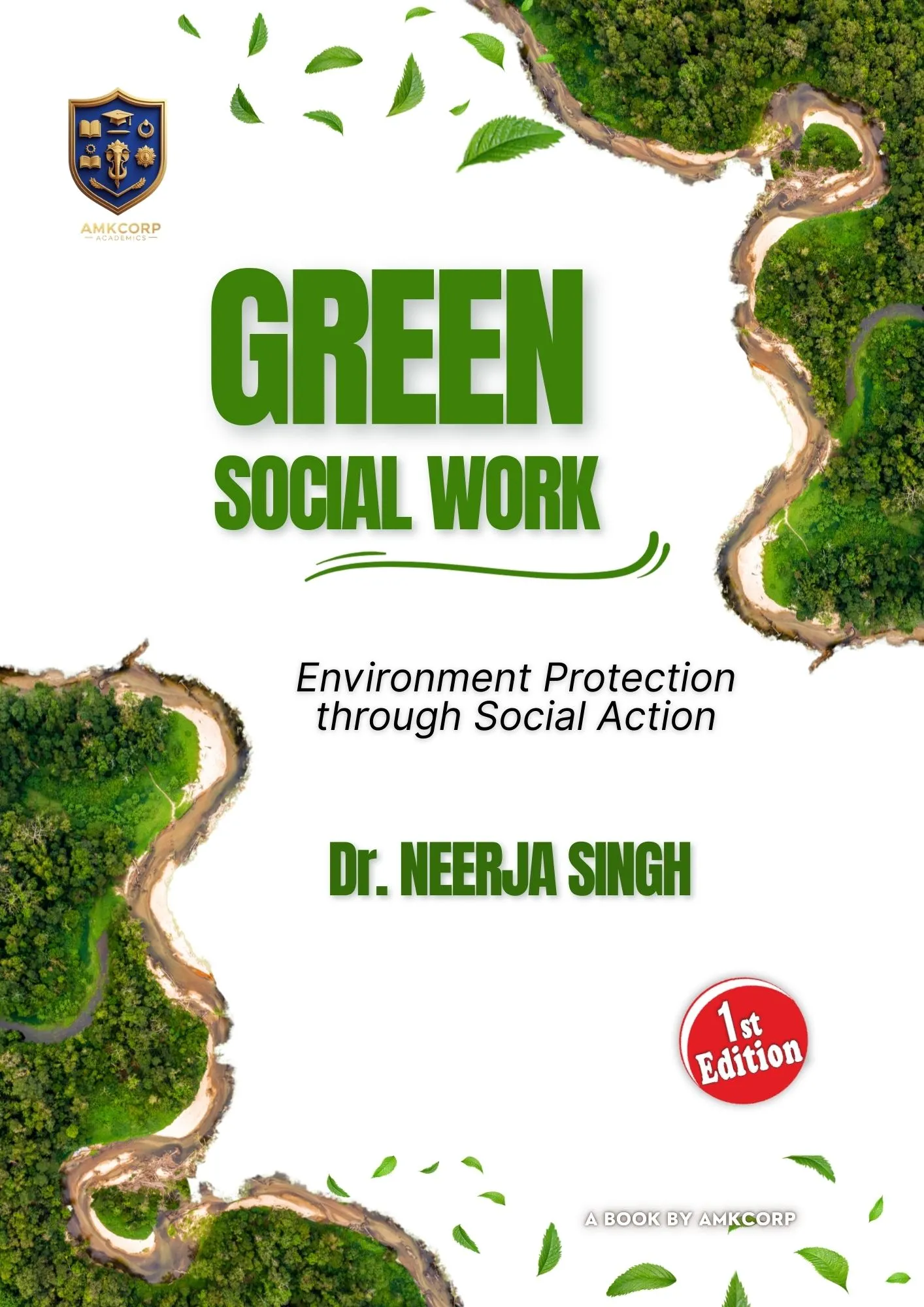
GREEN SOCIAL WORK
Environment Protection through Social Action
AUTHOR(S) -
Dr. NEERJA SINGH

DOI – 10.61909/AMKEDTB032657
Genre/Subject – Social Science, Green Social, Environmental Science
Book code – AMKEDTB032657 pgs: 230
ISBN(P) – 978-93-6556-948-3
ISBN(E) – 978-93-6556-038-1
Published – 06/03/2026
Edition – 1
BUY PRINT

BUY EBOOK
INTRODUCTION VIDEO

AUTHORS

Dr. NEERJA SINGH
Dr. Neerja Singh is an accomplished academician, researcher, and social work professional with extensive experience in teaching, research, and community development. She is currently serving as Assistant Professor (Senior Scale) in the Department of Social Work, School of Social Sciences at Uttarakhand Open University, Haldwani (Nainital), Uttarakhand, where she has been contributing to teaching, research, and academic development since January 2011.
Dr. Singh holds a Ph.D. in Social Work from the University of Lucknow, with her doctoral research focusing on women’s empowerment through political participation. She also earned her Master of Social Work (MSW) from the University of Lucknow and qualified the UGC-NET in Social Work. Her academic interests include women empowerment, social inclusion, rural development, community welfare, human rights, and social policy.
With over a decade of academic experience, Dr. Singh has actively contributed to the field of social work education through research publications, academic writing, and conference presentations at national and international levels. She has authored and co-authored several research papers published in peer-reviewed journals and contributed chapters in academic books related to social work practice, rural development, gender studies, and public welfare initiatives.
In addition to teaching and research, Dr. Singh has played an active role in curriculum development and academic administration. She has developed self-learning materials for undergraduate and postgraduate programmes, served as Head of Department and Programme Coordinator for the MSW programme, and contributed to examination, academic planning, and research initiatives at the university level. She has also worked as a question paper setter and academic contributor for various universities, including Lucknow University, Kumaun University, and Doon University.
Dr. Singh is actively associated with several professional bodies, including the National Council for Social Work Education (NCSWE), where she serves as State Coordinator for the Uttarakhand Chapter, and the National Association of Professional Social Workers in India. She has also been involved in organizing academic seminars, workshops, and conferences focusing on contemporary social issues.
Her research work has been recognized through several academic honours, including the Excellence in Teaching Award and the Women Scientist Award at the Xth International Conference on Global Research Initiatives for Sustainable Agriculture & Allied Sciences (GRISAAS-2025).
Through her academic work, Dr. Neerja Singh continues to contribute to social work education, policy discussions, and research aimed at strengthening social justice, empowerment, and sustainable community development in India.
ABOUT BOOK / ABSTRACT
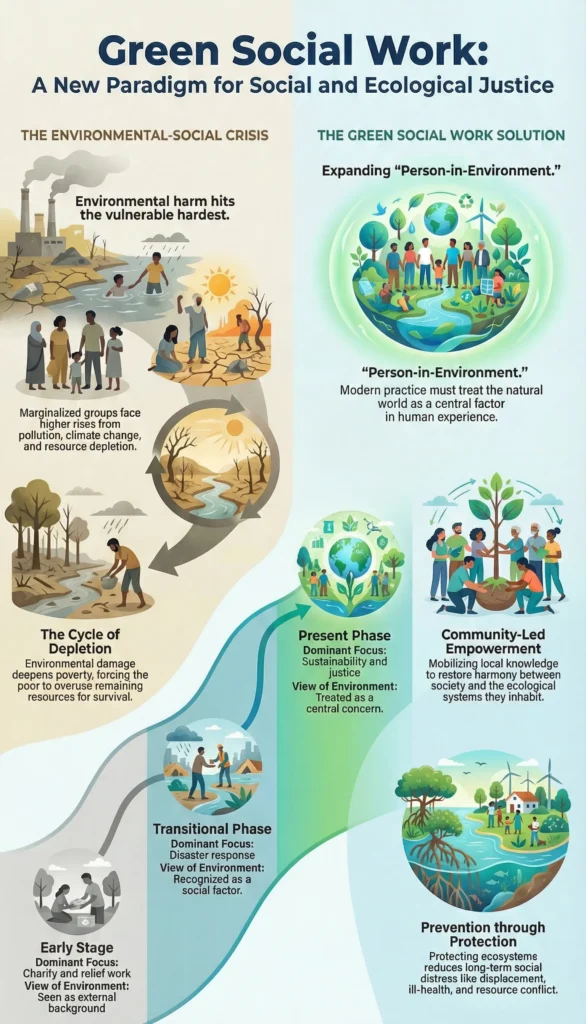
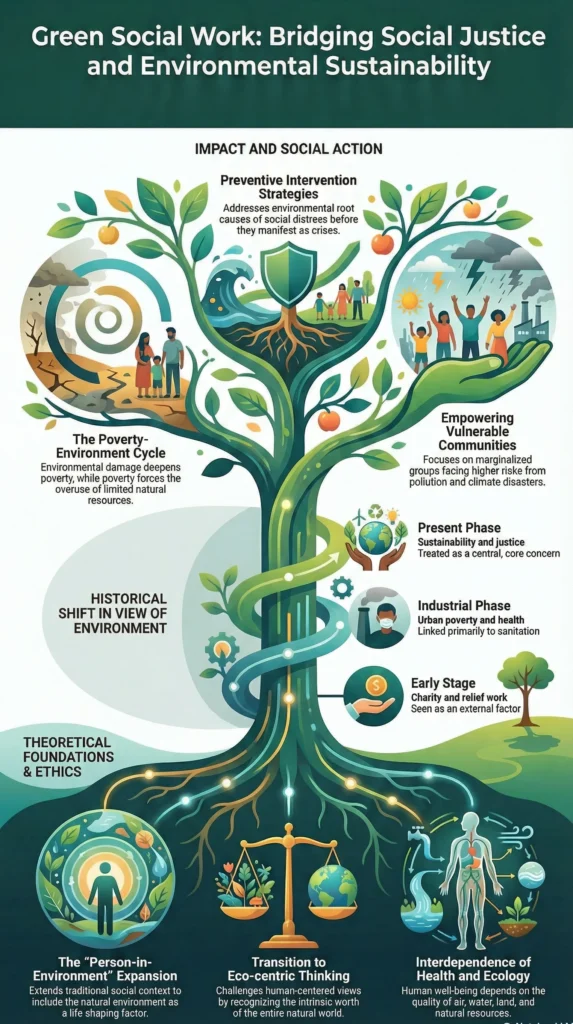
Green Social Work: Environment Protection through Social Action is a comprehensive and forward-looking text that explores the dynamic relationship between social work practice and environmental sustainability. The book recognizes that environmental problems are not isolated ecological issues but deeply connected to social inequality, poverty, human rights, and community well-being. It presents green social work as an emerging and necessary approach that integrates environmental protection with social justice, emphasizing that social workers play a critical role in building sustainable and resilient communities.
In an era marked by climate change, environmental degradation, and widening social disparities, this book offers a holistic understanding of how ecological concerns intersect with human development. It traces the evolution of environmental awareness within social work and explains how traditional methods of practice can be adapted to address environmental challenges. By connecting ecological systems theory, environmental justice, and sustainable development perspectives, the book builds a strong theoretical foundation for green practice.
The text further explores how industrialization, urbanization, and unchecked economic growth contribute to environmental crises that disproportionately affect vulnerable populations. It emphasizes the responsibility of social workers to advocate for policies that protect natural resources while promoting equity and inclusion. Through discussions on community mobilization, grassroots initiatives, and participatory approaches, the book highlights the power of collective action in addressing environmental problems.
Special attention is given to climate change, disaster risk reduction, and environmental resilience, illustrating how social workers can contribute to adaptation strategies and climate justice. The book also examines environmental laws, governance systems, and the role of non-governmental organizations in shaping sustainable policies. By bridging theory and practice, it provides practical insights into case work, group work, research, and community organization within environmental contexts.
Designed for students, educators, researchers, and practitioners in social work and related disciplines, this book serves as both an academic resource and a practical guide. It encourages professionals to adopt environmentally responsible practices and to integrate sustainability into everyday interventions. Ultimately, Green Social Work envisions a society where environmental protection and social development go hand in hand, fostering a future that is just, inclusive, and ecologically balanced.
BOOK MAP
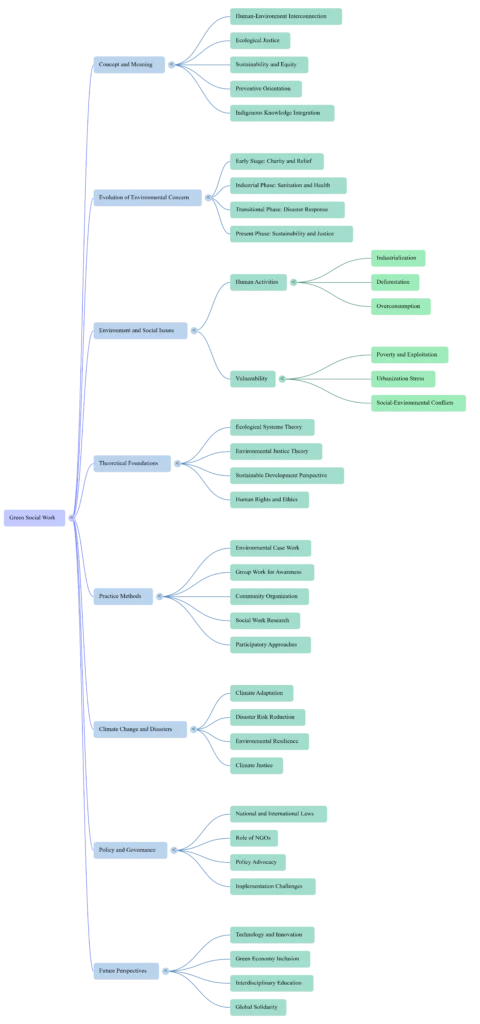
CHAPTERS
Chapter 1: Introduction to Green Social Work
This chapter introduces the concept, scope, and objectives of green social work. It explains the connection between society and the environment and highlights why environmental protection is essential in social work practice.
Chapter 2: Environment and Social Issues
This chapter examines how poverty, inequality, industrialization, and urbanization contribute to environmental degradation. It focuses on the impact of environmental risks on vulnerable communities.
Chapter 3: Theoretical Foundations of Green Social Work
This chapter discusses the major theories that guide green social work, including ecological systems theory and environmental justice. It provides a conceptual framework linking sustainability with human rights and ethics.
Chapter 4: Environmental Protection and Social Action
This chapter explores social action as a method for environmental change. It emphasizes community mobilization, advocacy, and grassroots initiatives for sustainability.
Chapter 5: Green Social Work Practice Methods
This chapter explains how traditional social work methods such as case work, group work, and research can address environmental issues. It promotes participatory approaches in practice.
Chapter 6: Climate Change and Social Work
This chapter analyzes climate change and its social impacts. It highlights the role of social workers in climate adaptation, disaster risk reduction, and promoting climate justice.
Chapter 7: Sustainable Development and Green Social Work
This chapter connects sustainable development with community well-being and social inclusion. It discusses natural resource management and the role of social workers in achieving sustainability.
Chapter 8: Environmental Policies and Legal Frameworks
This chapter reviews environmental policies, laws, and governance systems. It also explains the role of NGOs and social workers in policy advocacy and implementation.
Chapter 9: Community Participation and Environmental Awareness
This chapter focuses on the importance of community involvement and environmental education. It highlights the role of youth, women, and media in environmental movements.
Chapter 10: Green Social Work in Rural and Urban Settings
This chapter compares environmental issues in rural and urban areas. It addresses challenges such as slums, sanitation, and sustainable city development.
Chapter 11: Role of Social Workers in Environmental Protection
This chapter outlines professional responsibilities, ethical principles, and required skills for green practice. It discusses collaboration and practical challenges faced by social workers.
Chapter 12: Future Perspectives of Green Social Work
This concluding chapter explores emerging trends, technological innovations, and future opportunities in green social work. It presents a vision for a sustainable and environment-friendly society.