₹ 999.00
$99.00
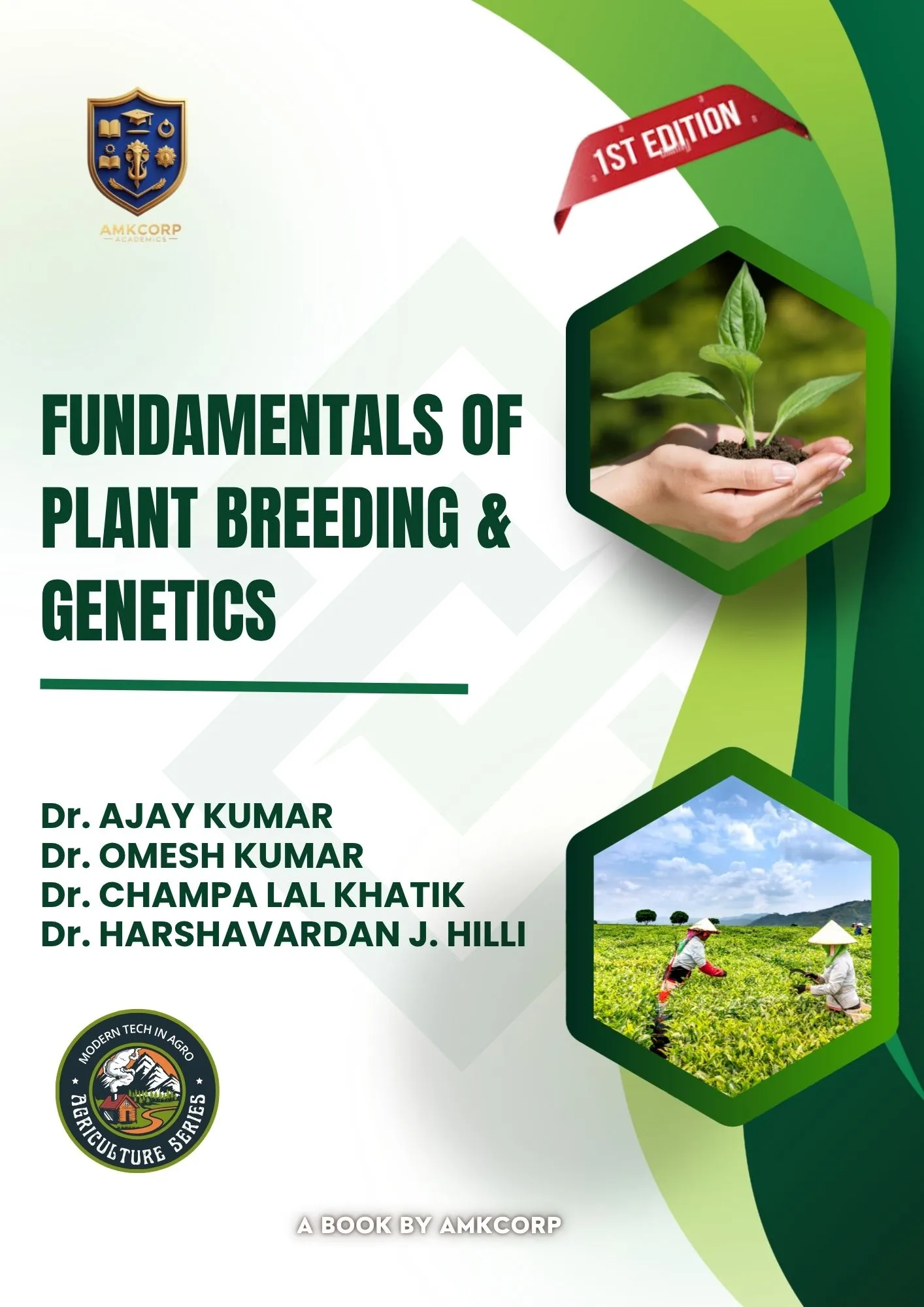
FUNDAMENTALS OF PLANT BREEDING & GENETICS
AUTHOR(S) -
Dr. AJAY KUMAR
Dr. OMESH KUMAR
Dr. CHAMPA LAL KHATIK
Dr. HARSHAVARDAN J. HILLI

DOI – 10.61909/AMKEDTB042664
Genre/Subject – Genetics, Plant Breeding
Book code – AMKEDTB042664 pgs: 236
ISBN(P) – 978-93-6556-908-7
ISBN(E) -978-93-6556-444-0
Published – 06/04/2026
Edition – 1
BUY PRINT

BUY EBOOK
INTRODUCTION VIDEO

AUTHORS

Dr. AJAY KUMAR
Prof. (Dr.) Ajay Kumar (b. 1968) is an eminent scholar in the field of Genetics and Plant Breeding, with over three decades of experience in teaching, research, and academic mentorship. He has made significant contributions to agricultural education and to the advancement of maize research and development.
His work has led to the commercial release of ten maize varieties, including field corn, QPM, baby corn, and popcorn. He has published more than 52 research papers in reputed national and international journals and has contributed books, practical manuals, and book chapters to the academic community. He has also participated in numerous national and international conferences and has supervised nearly 16 postgraduate and Ph.D. scholars in their research work.
A respected teacher, researcher, and guide, Prof. Kumar has been honoured with 20 awards and recognitions from various state, national, and international organizations. This book reflects his scholarship, experience, and enduring commitment to advancing knowledge and supporting students and young scholars.

Dr. OMESH KUMAR
Dr. Omesh Kumar is an Assistant Professor in the Department of Genetics and Plant Breeding at the College of Agriculture, Kotputli, Sri Karan Narendra Agriculture University, Jobner, Rajasthan. He earned his Ph.D. in Genetics and Plant Breeding from Banaras Hindu University, Varanasi. He completed his M.Sc. (Ag.) in Genetics and Plant Breeding from the University of Agricultural Sciences, Dharwad, and his B.Sc. (Ag.) from SK Rajasthan Agricultural University, Bikaner. He has qualified the ICAR–ASRB NET and CSIR–UGC NET examinations. With over 2.5 years of experience in teaching, research, and extension, His research interests include abiotic stress tolerance, iron deficiency chlorosis and crop improvement. He has published extensively in reputed national and international journals and has contributed significantly to research on groundnut and Indian mustard.

Dr. CHAMPA LAL KHATIK
Dr. Champa Lal Khatik is an Agricultural Scientist and Academician Serving as an Assistant Professor in Genetics and Plant Breeding (GPB) at the Agricultural Research Station (ARS), Fatehpur, under Sri Karan Narendra Agriculture University, Jobner (Rajasthan).He specializes in crop improvement through modern breeding techniques and genetic research. His work focuses on developing high-yielding, disease-resistant and climate-resilient crop varieties to support sustainable agriculture. Along with research, he is actively involved in teaching and guiding students in agricultural sciences. Dr. Khatik also contributes to farmer welfare by spreading awareness about improved seeds, modern farming practices and government agricultural schemes. Through his combined efforts in research, education and extension activities, he plays an important role in enhancing agricultural productivity and rural development.

Dr. HARSHAVARDAN J. HILLI
Dr. Harshavardan J. Hilli is currently serving as an Assistant Professor in the Department of Genetics & Plant Breeding at PGCA, RPCAU, Pusa, Samastipur, Bihar, India. He holds a Ph.D. in Plant Breeding and Genetics from Punjab Agricultural University (PAU), Ludhiana, completed in 2023. Prior to this, he earned his M.Sc. in Agriculture (Genetics & Plant Breeding) from AC Vijayapur, UAS Dharwad (2019), and his B.Sc. in Agriculture from AC Kalaburagi, UAS Raichur (2017), Karnataka.
Dr. Hilli specializes in both conventional and molecular breeding approaches in self- and cross-pollinated crops. His research primarily focuses on drought and disease resistance, hybridization techniques, and quantitative trait loci (QTL) mapping. He has made notable contributions to crop improvement research, particularly in oats and sunflower, with an emphasis on enhancing yield, stress tolerance, and disease resistance.
He has authored and co-authored numerous research articles published in reputed national and international journals, including The Plant Genome, Cereal Research Communications, and The Indian Journal of Agricultural Sciences. His work includes pioneering studies on QTL mapping for disease resistance in oats and evaluations of sunflower lines under drought conditions. Additionally, he has contributed to book chapters published by leading international publishers such as Springer Nature.
Dr. Hilli ’s research contributions extend to interdisciplinary areas such as phenomics, forage production, and genetic diversity analysis. His scholarly work reflects a strong commitment to advancing sustainable agriculture and improving crop productivity under changing climatic conditions.
He is actively involved in academic research, teaching, and mentoring students in the field of plant breeding and genetics. His professional identifiers include
ABOUT BOOK / ABSTRACT
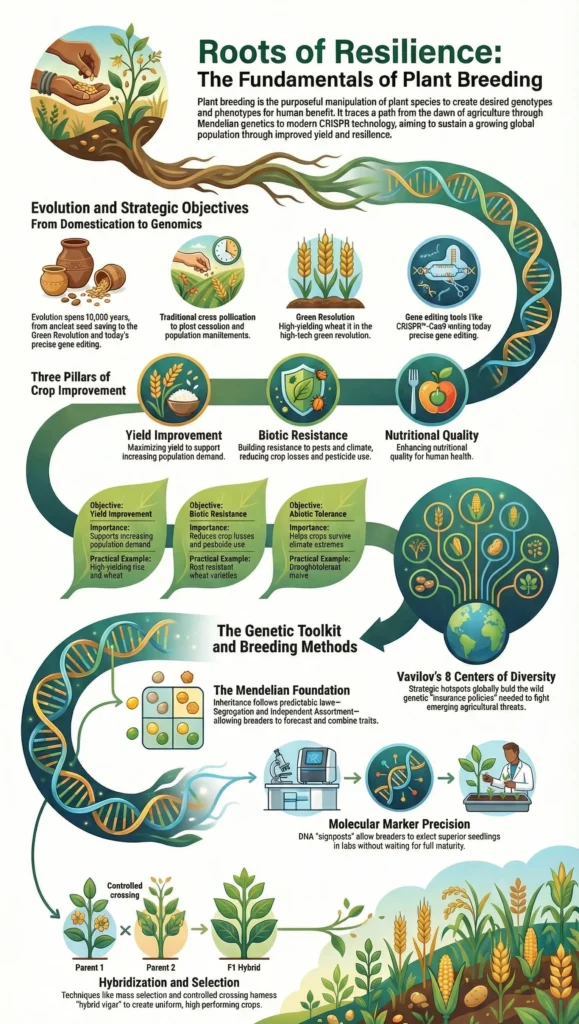
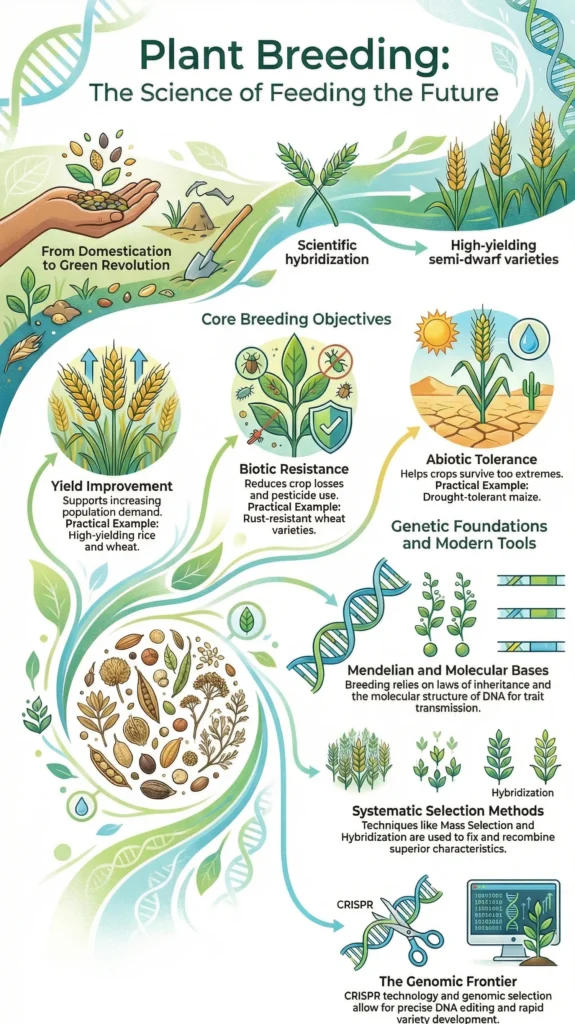
Fundamentals of Plant Breeding & Genetics is an essential textbook that offers a thorough and up-to-date exploration of the scientific principles underlying the improvement of crop plants. In an era where global food security is challenged by population growth, climate change, pest and disease pressures, and shrinking arable land, plant breeding stands as a vital tool for developing high-yielding, nutritious, and resilient crop varieties. This book provides readers with a complete journey from the historical roots of plant breeding to the latest advancements in biotechnology and genomics. The text begins by introducing the field, its evolution, objectives, and the role it plays in modern agriculture. It builds a strong foundation in classical genetics through detailed coverage of Mendelian principles, gene interactions, and chromosomal behavior. Readers will gain insights into quantitative genetics, which is crucial for understanding complex traits like yield and stress tolerance that are governed by multiple genes and environmental interactions. Moving into molecular aspects, the book covers DNA structure, gene expression, mutations, and the application of molecular markers in breeding programs. It extensively discusses cytogenetics, including polyploidy, which has played a significant role in the evolution of many crop species. Practical breeding methodologies are emphasized in chapters dedicated to pollination biology, selection methods, hybridization techniques, and heterosis. The integration of modern tools such as tissue culture, genetic engineering, GM crops, and CRISPR-based genome editing demonstrates how biotechnology is revolutionizing traditional breeding approaches. Furthermore, the book addresses critical post-breeding aspects including seed production, variety testing and release, intellectual property rights, and the role of national and international institutions. This holistic approach ensures that readers understand not only the science but also the regulatory and commercial frameworks that govern the deployment of new plant varieties. Written in clear, accessible language with relevant examples, diagrams, and case studies, Fundamentals of Plant Breeding & Genetics is ideal for undergraduate and postgraduate students in agriculture, plant sciences, genetics, and biotechnology. It also serves as a valuable reference for researchers, plant breeders, and extension workers aiming to translate genetic knowledge into practical crop improvement strategies. By mastering the concepts presented in this book, readers will be well-equipped to contribute to sustainable agricultural development and global food security.
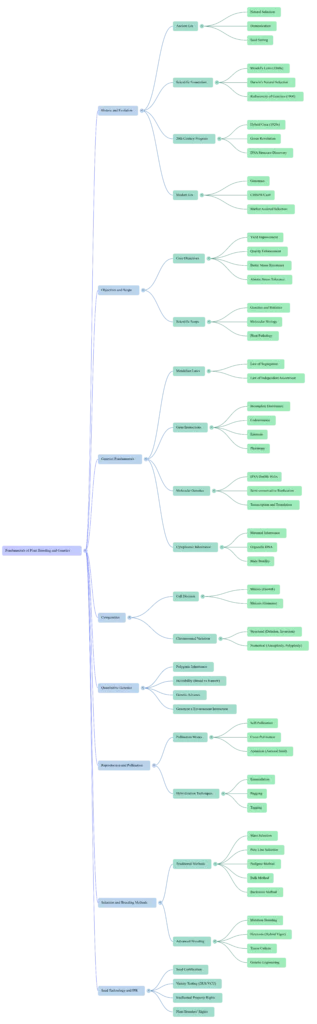
BOOK MAP
CHAPTERS
Chapter 1: Introduction to Plant Breeding & Genetics
This chapter lays the foundation by exploring the history and evolution of plant breeding from ancient practices to modern scientific approaches. It outlines the objectives and scope of plant breeding in improving crop productivity and quality. Readers will learn about basic genetics concepts, centers of origin and diversity of crop plants, and the significant role plant breeding plays in global agriculture and food security.
Chapter 2: Mendelian Genetics and Its Extensions
Focusing on classical genetics, this chapter covers Mendel’s Laws of Inheritance and their application through monohybrid and dihybrid crosses. It examines deviations from expected Mendelian ratios and explores advanced topics such as multiple alleles, gene interactions, and cytoplasmic inheritance. These concepts are fundamental for understanding trait inheritance in plant populations.
Chapter 3: Molecular Genetics and Gene Structure
This chapter introduces the molecular basis of heredity, detailing DNA structure, replication, and gene expression mechanisms. Topics include genetic code, protein synthesis, mutations, and DNA repair. It also discusses the application of molecular markers in modern plant breeding for efficient selection and genetic analysis.
Chapter 4: Cytogenetics and Chromosomal Behavior
Readers gain insights into chromosome structure, function, and behavior during cell division through mitosis and meiosis. The chapter addresses structural and numerical chromosomal variations, polyploidy, aneuploidy, and various cytogenetic techniques used in plant improvement programs.
Chapter 5: Quantitative Genetics
Dealing with complex, polygenic traits, this chapter explains polygenic inheritance, heritability, genetic advance, and components of genetic variance. It covers genotype × environment interactions and methods for predicting selection response, crucial for breeding programs targeting yield and other quantitative characters.
Chapter 6: Modes of Reproduction and Pollination Biology
This chapter explores floral biology, reproductive systems, and different pollination mechanisms including self and cross-pollination. It discusses strategies promoting cross-pollination, hybridization techniques, and the phenomenon of apomixis and its applications in plant breeding.
Chapter 7: Selection Methods in Plant Breeding
Focusing on practical breeding techniques, this section details various selection methods such as mass selection, pure line selection, clonal selection, and progeny selection. It also introduces modern selection strategies used in contemporary plant improvement.
Chapter 8: Hybridization and Breeding Methods
This chapter covers the principles of hybridization and key breeding methods including pedigree, bulk, and backcross methods. Special emphasis is placed on heterosis and hybrid breeding techniques for developing high-yielding varieties.
Chapter 9: Mutation Breeding and Biotechnology
Introducing advanced tools, this chapter discusses mutation breeding using physical and chemical mutagens. It explores tissue culture applications, genetic engineering, GM crops, and revolutionary genome editing technologies like CRISPR.
Chapter 10: Seed Production, Variety Release & IPR
The final chapter addresses the practical end of breeding: seed certification, quality control, variety testing and release procedures. It also covers intellectual property rights, plant breeders’ rights, and the role of various institutions in plant breeding.