₹ 999.00
$99.00
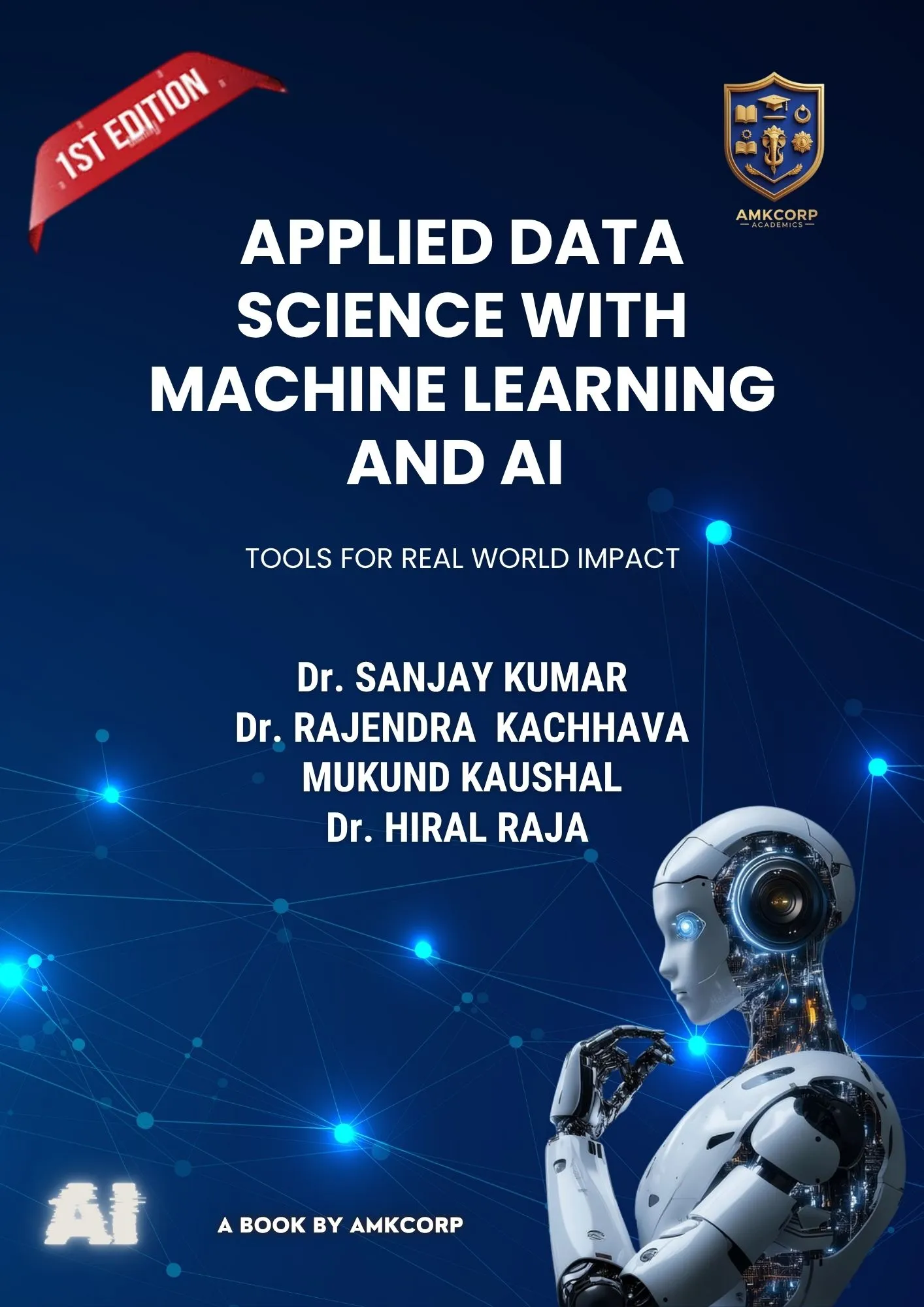
APPLIED DATA SCIENCE WITH MACHINE LEARNING AND AI
TOOLS FOR REAL WORLD IMPACT
AUTHOR(S) -
Dr. SANJAY KUMAR, Dr. RAJENDRA KACHHAVA,
MUKUND KAUSHAL, Dr. HIRAL RAJA

DOI – 10.61909/AMKEDTB042666
Genre/Subject – Data Science, AI, ML.
Book code – AMKEDTB042666 pgs: 225
ISBN(P) -978-93-6556-302-3
ISBN(E) – 978-93-6556-541-6
Published – 13/04/2026
Edition – 1
BUY PRINT

BUY EBOOK
INTRODUCTION VIDEO

AUTHORS
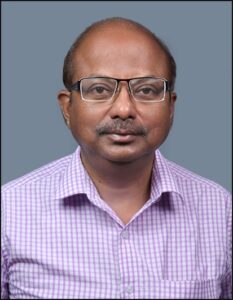
Dr. SANJAY KUMAR
Dr. Sanjay Kumar completed B.E. in Electrical Engineering from Govt. Engineering College, Raipur (now NIT, Raipur) in the year 1988, M.E. in Computer Science and Engineering from M.N.R. Engineering College, Allahabad (now MNNIT, Allahabad) in the year 2000 and Ph.D. in Computer Science and Engineering from Pt. Ravishankar Shukla University, Raipur in the year 2005 with Govt. Engineering College, Raipur (presently NIT, Raipur) as centre.
At present, he is Professor, Head of the Department and Dean of Computer Science and IT at Pt. Ravishankar Shukla University, Raipur, which is a NAAC ‘’A+’’ Grade, State Govt. University. He is Chairman of The Institution of Engineers, Chhattisgarh State Centre. He has served as Chairman in expert committees of AICTE, UGC, NAAC, IIT Bhilai etc.
Computer Networking and Parallel Computing are the areas of his interest. Ten candidates are awarded Ph.D. under his guidance. He has more than 100 research papers to his credit in the reputed journals and conferences. He has delivered more than 100 lectures in the renowned Indian and Foreign Universities like Oxford University, California University etc. He has written various articles in News Papers. All India Radio, Raipur and Doordarshan Chhattisgarh have broadcasted his interviews on Technical Topics like Green Computing, Cyber Security, Digital Education, E-Waste etc. He has worked on India’s first Super Computer “Param” at NIT Allahabad. He has uploaded around 100 lectures in his You Tube Channel “Dr. Sanjay Kumar, India”.

Dr. RAJENDRA KACHHAVA
Dr. Rajendra Kachhava (Ph.D, M.Tech, B.E. MCT) currently working as an Assistant Professor in Computer Science Department at Institute of Information Technology Kota Rajasthan.
He has more than 16 years of teaching and industrial experience. He has diversified research interest in the area of data analytics, cloud computing, data mining and machine learning. He is member of IEEE, CSI and IRED. He has published over 25 research paper in international, national journal and conferences and attended around 30 workshop and FDP. He is a microsoft certified trainer MCT and he has delivered more than 80 corporate training sessions globally, including in the USA, UK, Australia, India, and UAE in field of data science, data analyst, Power BI, DBMS, and Microsoft Certification courses.

MUKUND KAUSHAL
Mukund Kaushal Patel is currently serving as a Lecturer at Government Engineering College, Bilaspur, Chhattisgarh. He has been actively involved in technical education and teaching since October 2016, when he joined Government Girls Polytechnic, Bilaspur through the Chhattisgarh Public Service Commission (CGPSC). In October 2024, he was transferred to Government Engineering College, Bilaspur, where he continues to contribute to engineering education and academic development.
Mr. Patel completed his Bachelor of Engineering (B.E.) in Information Technology from Rungta College of Engineering and Technology, Bhilai, affiliated with Chhattisgarh Swami Vivekananda Technical University (CSVTU), Bhilai, in 2009 with First Division. He further pursued his Master of Technology (M.Tech.) in Nanotechnology from Maulana Azad National Institute of Technology (MANIT), Bhopal, Madhya Pradesh, and graduated in 2013 with First Division.
During his teaching career in polytechnic education, he has taught a wide range of subjects including Computer Fundamentals and its Applications, Computer Troubleshooting and Maintenance, Object-Oriented Programming using Java, Programming in C++, Dynamic Webpage Design (ASP), Web Scripting (JavaScript and PHP), Network Management, Emerging Trends and Technologies, Multimedia Technology (Photoshop and Flash), C Programming, and Mobile Application Development using Android.
At the engineering college level, he has been teaching core and advanced computer science subjects such as Fundamentals of Computer, E-Commerce and Strategic IT, Data Structures using C++, Wireless Sensor Networks, Big Data Analytics, and Machine Learning Laboratory.
Mr. Patel’s academic interests include programming, emerging computing technologies, data structures, and modern web technologies. He is dedicated to enhancing students’ practical and conceptual understanding of computer science and related technologies. Through his teaching and academic contributions, he continues to support the development of skilled engineers and technologists.
Dr. HIRAL RAJA
Dr. Hiral Raja is working as an Associate Professor in the Department of Mathematics at Dr. C. V. Raman University. She completed her Doctoral Degree (Ph.D.) in Fixed Point Theory. She is a registered Ph.D. guide at CVRU and is currently supervising six Ph.D. scholars. Raja has published several research papers in UGC CARE-listed and Scopus-indexed journals. She has actively participated in numerous national and international conferences, seminars, workshops, and symposiums. She also serves as a reviewer for many national and international journals. She possesses strong academic and research experience in various areas of Mathematics. Additionally, she has served in an editorial role for a book published by CRC Press. She has successfully published and been granted four national and international patents.
ABOUT BOOK / ABSTRACT
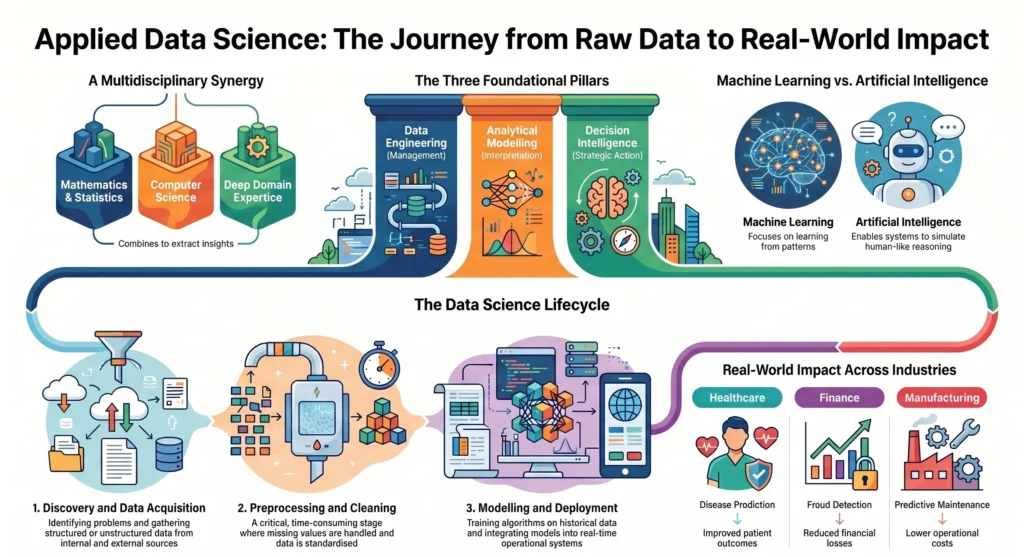
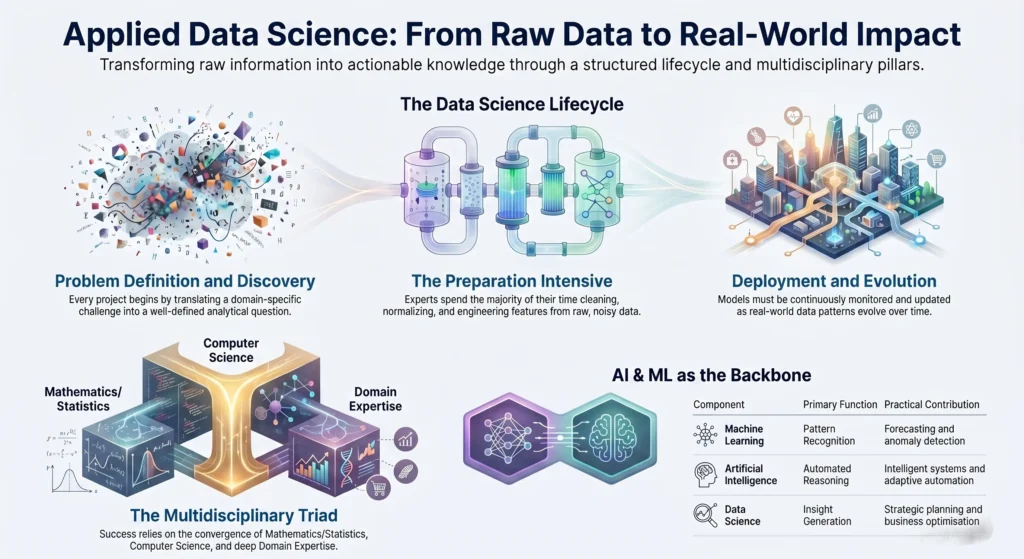
Applied Data Science with Machine Learning and AI – Tools for Real World Impact is a comprehensive and practical guide designed for students, professionals, and aspiring data scientists who want to understand how data-driven technologies are transforming industries. This book bridges the gap between theoretical knowledge and real-world application by presenting a structured approach to learning data science, machine learning, and artificial intelligence in an integrated manner. It begins with foundational concepts and gradually advances toward complex techniques, ensuring that readers develop both conceptual clarity and practical skills.
The book emphasizes the importance of understanding the complete data science lifecycle, from data collection to model deployment, enabling readers to work on real-world problems with confidence. It explores how machine learning and AI play a crucial role in extracting meaningful insights from data and automating decision-making processes. By focusing on real-world applications across industries such as healthcare, finance, engineering, and business, the content ensures relevance and applicability in modern professional environments.
A strong focus is placed on data preparation and preprocessing, which are often the most critical yet overlooked stages in any data science project. Readers will learn how to handle missing data, perform feature engineering, and conduct exploratory data analysis to uncover patterns and trends. The book then introduces the core principles of machine learning, including supervised, unsupervised, and reinforcement learning, along with evaluation metrics and model optimization techniques.
To build a solid analytical foundation, the book also covers essential statistical methods such as probability theory, hypothesis testing, regression analysis, and time series modeling. Moving into advanced topics, it explores deep learning and neural networks, including convolutional and recurrent architectures, as well as modern innovations like transformers and transfer learning.
In addition to theory, the book provides practical exposure to widely used tools and platforms such as Python, TensorFlow, PyTorch, and cloud-based AI systems. It also highlights the importance of MLOps and model deployment, preparing readers to implement scalable and production-ready solutions. Visualization techniques are included to help communicate insights effectively.
The later chapters focus on domain-specific applications, demonstrating how data science is applied in business decision-making, customer analytics, fraud detection, healthcare diagnostics, and smart engineering systems. Ethical considerations, data privacy, and responsible AI practices are also discussed in detail, ensuring that readers understand the broader impact of their work.
Finally, the book concludes with capstone projects and real-world case studies that allow readers to apply their knowledge in practical scenarios. It also explores future trends and innovations in AI, encouraging readers to stay ahead in this rapidly evolving field. Overall, this book serves as a complete roadmap for anyone looking to build a successful career in applied data science and artificial intelligence.
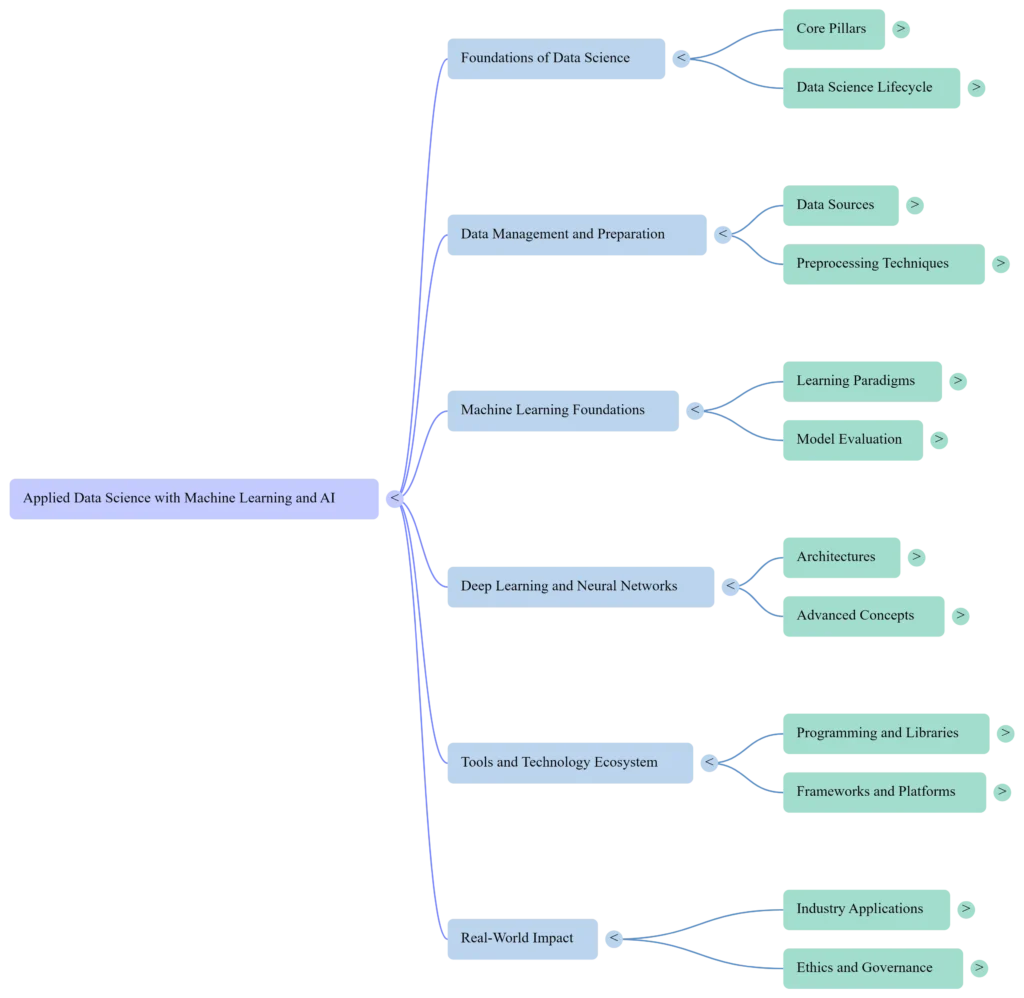
BOOK MAP
CHAPTERS
Chapter 1: Introduction to Applied Data Science
This chapter introduces the concept of data science and explains how machine learning and AI contribute to modern data-driven solutions. It also outlines the data science lifecycle and highlights real-world applications and tools used across industries.
Chapter 2: Data Collection and Preparation
This chapter focuses on gathering and preparing data for analysis. It covers data sources, cleaning techniques, handling missing values, feature engineering, and exploratory data analysis to ensure high-quality datasets.
Chapter 3: Foundations of Machine Learning
This chapter explains the core concepts of machine learning, including supervised, unsupervised, and reinforcement learning. It also discusses evaluation metrics and the bias-variance tradeoff for building effective models.
Chapter 4: Statistical Methods for Data Science
This chapter provides a strong statistical foundation by covering probability theory, hypothesis testing, regression, Bayesian methods, and time series analysis for data-driven decision making.
Chapter 5: Deep Learning and Neural Networks
This chapter introduces neural networks and advanced deep learning architectures such as CNNs, RNNs, and transformers. It also explores transfer learning for improving model performance.
Chapter 6: AI Tools and Platforms
This chapter presents essential tools like Python, TensorFlow, and PyTorch, along with cloud platforms, MLOps practices, and visualization tools used for building and deploying AI solutions.
Chapter 7: Applied Data Science in Business
This chapter demonstrates how data science is used in business applications such as predictive analytics, customer segmentation, fraud detection, recommendation systems, and decision intelligence.
Chapter 8: Applied Data Science in Engineering and Healthcare
This chapter explores applications in engineering and healthcare, including predictive maintenance, medical imaging, natural language processing, IoT systems, and autonomous technologies.
Chapter 9: Ethics, Governance, and Responsible AI
This chapter discusses ethical AI practices, bias and fairness, data privacy, regulatory frameworks, and explainable AI to ensure responsible use of technology.
Chapter 10: Capstone Projects and Real-World Case Studies
This chapter provides hands-on learning through projects and case studies. It covers end-to-end workflows, industry applications, innovation strategies, and future trends in AI.