₹ 999.00
$99.00
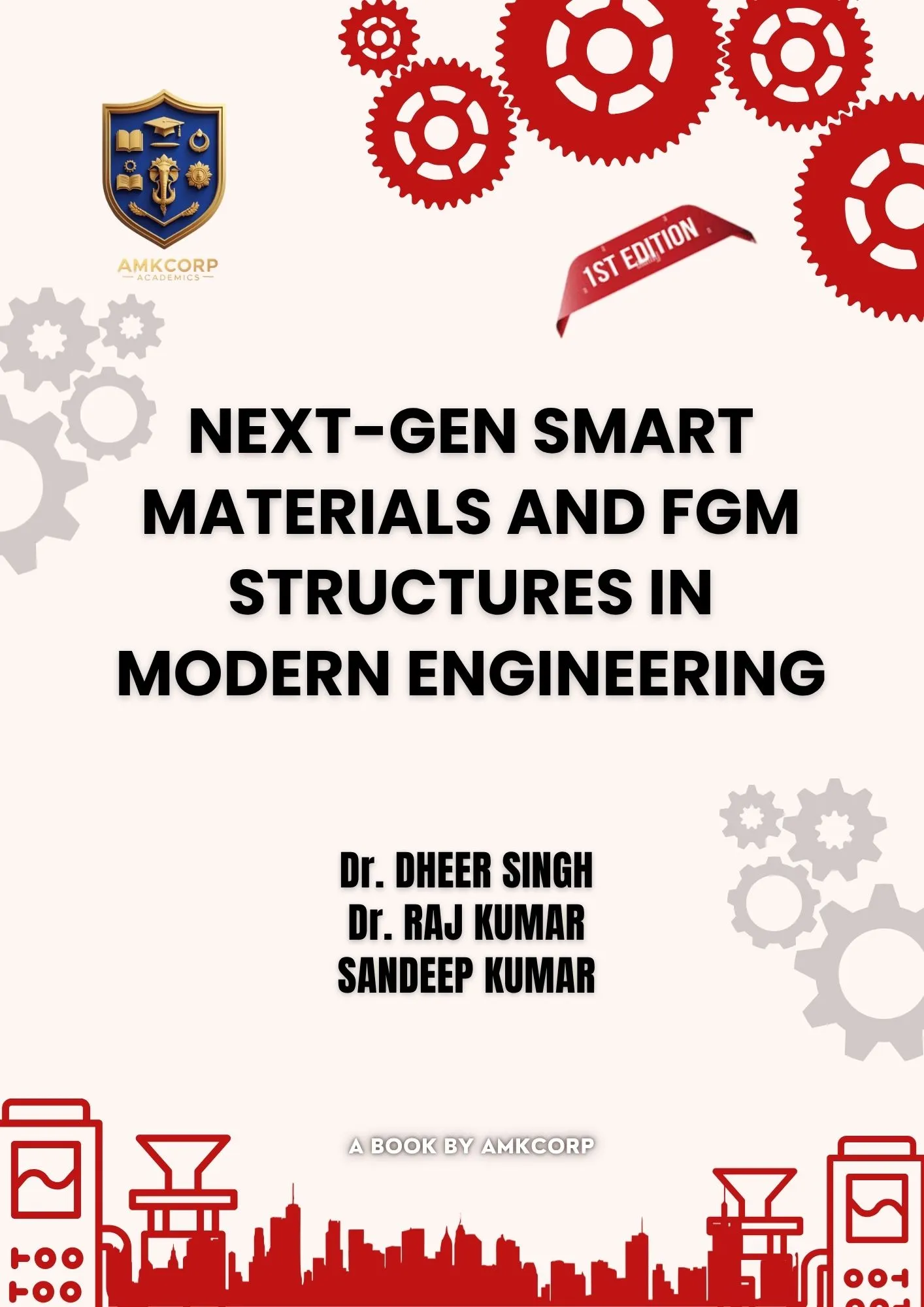
NEXT-GEN SMART MATERIALS AND FGM STRUCTURES IN MODERN ENGINEERING
AUTHOR(S) -
Dr. DHEER SINGH
Dr. RAJ KUMAR
SANDEEP KUMAR

DOI – 10.61909/AMKEDTB062679
Genre/Subject – Mechanical Engineering, Material Science
Book code – AMKEDTB062679 pgs: 250
ISBN(P) – 9978-93-6556-015-2
ISBN(E) – 978-93-6556-014-5
Published – 15/06/2026
Edition – 1
BUY PRINT

BUY EBOOK
AUTHORS

Dr. DHEER SINGH
Dr. Dheer Singh is a Associate Professor in the Faculty of Engineering and Technology (FOET) at Madhav University, Rajasthan, India. He earned his Bachelor of Engineering (B.E.) in Automobile Engineering from RJIT, BSF Academy, Tekanpur, Gwalior, and completed his Master of Technology (M.Tech.) in Mechanical Engineering with specialization in Design of Mechanical Equipment from the Indian Institute of Technology (IIT) Delhi. He subsequently obtained his Ph.D. from Shiv Nadar University, Delhi NCR, where his doctoral research focused on “Vibration Analysis of Functionally Graded Sandwich Plate Structures.”
Dr. Singh’s research interests encompass Computational Mechanics, Mechanics of Composite Materials, Functionally Graded Material (FGM) Structures, Finite Element Methods (FEM), Machine Learning-based Artificial Neural Network (ANN) techniques, and Condition Monitoring of Gears and Mechanical Systems. His work integrates advanced numerical modeling, intelligent computational approaches, and engineering applications to address complex challenges in modern mechanical systems.
He has authored numerous research papers published in reputed international journals and has presented his findings at several national and international conferences. In addition, he has filed multiple patents, reflecting his commitment to innovation, technology development, and the advancement of intellectual property.
With over eight years of experience in teaching, research, academic administration, and project management, Dr. Singh has held several key academic and administrative positions, including Controller of Examinations (COE), Associate Professor, Assistant Professor, and Patent Coordinator at various national and international institutions. He also possesses extensive expertise in Intellectual Property Rights (IPR), including patent drafting, filing, prosecution, First Examination Report (FER) responses, and pre- and post-grant opposition proceedings.
Through his contributions to engineering education, research, innovation, and academic leadership, Dr. Singh continues to advance excellence in higher education and promote cutting-edge research in advanced composite materials, with a particular focus on Functionally Graded Material (FGM) structures, computational mechanics, and their engineering applications.

Dr. RAJ KUMAR
Dr. Raj Kumar is a Postdoctoral Researcher in the Department of Mechanical Engineering at Clemson University, USA. He earned his Ph.D. from the Indian Institute of Technology Kharagpur, specializing in static and dynamic analysis of advanced composite structures using closed-form dynamic stiffness formulations. His research interests include computational mechanics, structural dynamics, composite and functionally graded materials, microstructure reconstruction, dynamic stiffness method, finite element method, and machine-learning-assisted modeling. Dr. Kumar has authored multiple peer-reviewed articles in several leading international journals and attended several national and international conferences.

SANDEEP KUMAR
Mr. Sandeep Kumar is a Ph.D. Research Scholar in the Department of Mechanical Engineering at Shiv Nadar Institution of Eminence, India. He completed his M.Tech. in Machine Design from the Indian Institute of Technology (IIT) Guwahati and his B.Tech. in Mechanical Engineering from UIET, Maharshi Dayanand University, Rohtak. His doctoral research focuses on the nonlinear modelling of magneto-active elastomers under large deformation. His research interests include magneto-active elastomers, nonlinear continuum mechanics, finite element methods (FEM), Abaqus/VUMAT implementation, hyperelastic constitutive modelling, magneto-mechanical coupling, variational asymptotic methods, soft actuators, smart material systems, and experimental characterization of elastomers.
ABOUT BOOK / ABSTRACT
NEXT-GEN SMART MATERIALS AND FGM STRUCTURES IN MODERN ENGINEERING is a comprehensive textbook designed for undergraduate and postgraduate students of Mechanical Engineering, Materials Science, and related disciplines. The book provides a clear understanding of smart materials, composite materials, their properties, classifications, applications, and emerging trends in modern engineering. Special emphasis has been given to the applications of smart materials in mechanical engineering, including vibration control, adaptive structures, sensors, actuators, robotics, structural health monitoring, and energy-efficient systems. The text includes engineering concepts, mathematical models, comparison tables, and practical applications to help students and researchers understand both theoretical and practical aspects of the subject. This book serves as a useful resource for students, teachers, researchers, and practicing engineers interested in advanced materials and intelligent engineering systems.
BOOK MAP
CHAPTERS
Chapter 1
The field of materials engineering has undergone a remarkable transformation over the past few decades, driven by the growing demand for advanced materials capable of meeting complex functional requirements. Traditional.
Chapter 2
Composite materials are an essential part of modern engineering and materials science. They are designed by combining two or more constituent materials with distinct physical or chemical properties to produce.
Chapter 3
Concept of Smart Composite Materials
Chapter 4
Piezoelectricity is a phenomenon in which certain materials generate an electric charge in response to applied mechanical stress. This remarkable property enables direct coupling between mechanical and electrical domains, forming.
Chapter 5
Shape Memory Effect and Superelasticity
Chapter 6
Magnetostrictive and Electroactive Composites
Chapter 7
Damage Detection in Composite Structures
Chapter 8
Self-healing composite materials represent a rapidly evolving class of intelligent materials designed to autonomously repair damage and restore mechanical integrity without external intervention. The concept is inspired by biological systems
Chapter 9
Functionally Graded Materials (FGMs) Structures
Chapter 10
Conventional Composite Manufacturing Techniques
Chapter 11
Modeling and Analysis of Smart Composites
Chapter 12
Applications of Smart Composite Materials
Chapter 13
Challenges and Future Scope of Smart Composite Materials