₹ 999.00
$99.00
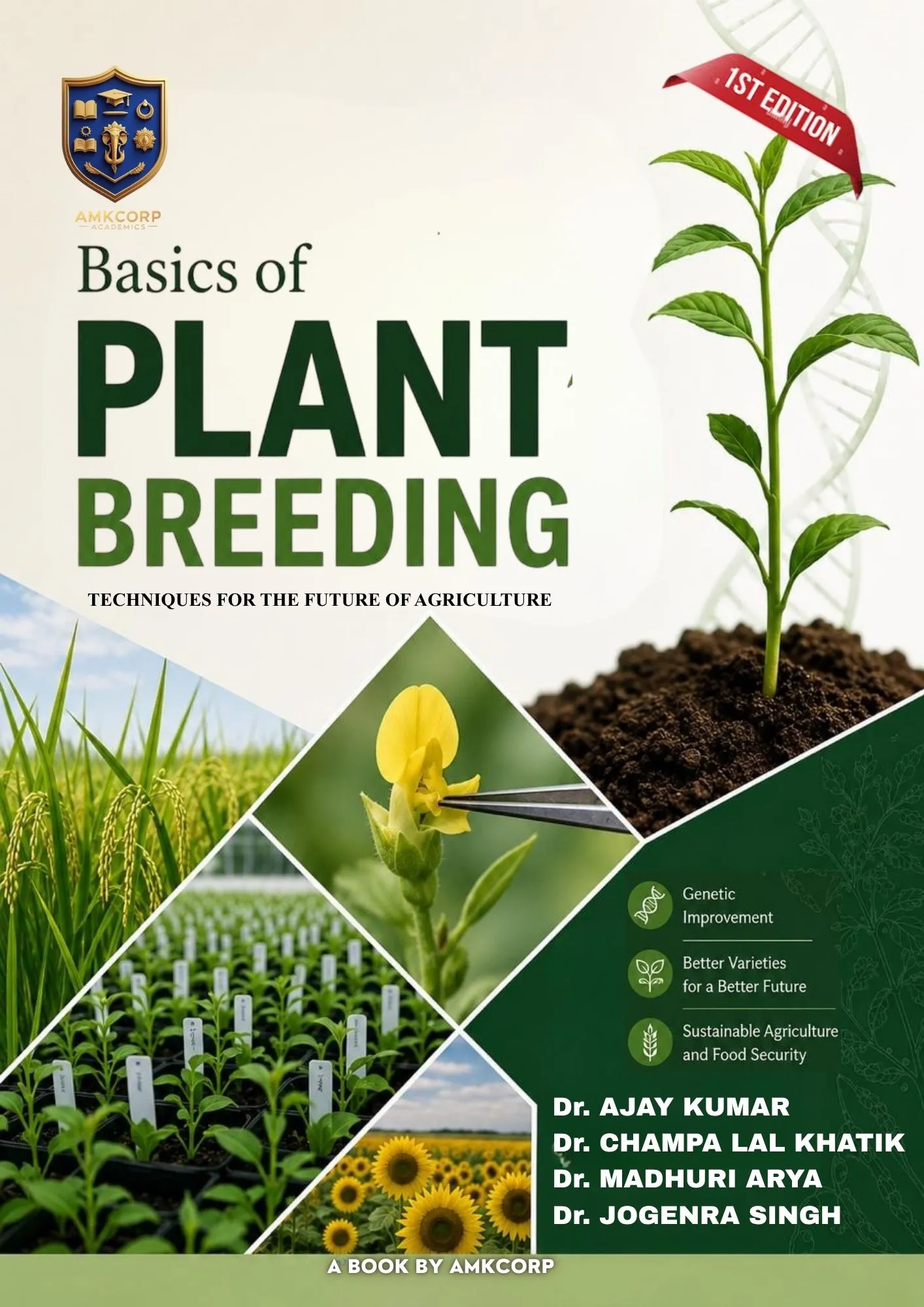
BASICS OF PLANT BREEDING
TECHNIQUES FOR THE FUTURE OF AGRICULTURE
AUTHOR(S) -
Dr. AJAY KUMAR, Dr. CHAMPA LAL KHATIK,
Dr. MADHURI ARYA, Dr. JOGENRA SINGH

DOI – 10.61909/AMKEDTB062677
Genre/Subject – Agriculture, Plant Science
Book code – AMKEDTB062677 pgs: 250
ISBN(P) – 978-93-6556-009-1
ISBN(E) – 978-93-6556-008-4
Published – 15/06/2026
Edition – 1
BUY PRINT

BUY EBOOK
INTRODUCTION VIDEO
AUTHORS

Dr. AJAY KUMAR
Prof. (Dr.) Ajay Kumar (b. 1968) is an eminent scholar in the field of Genetics and Plant Breeding, with over three decades of experience in teaching, research, and academic mentorship. He has made significant contributions to agricultural education and to the advancement of maize research and development.
His work has led to the commercial release of ten maize varieties, including field corn, QPM, baby corn, and popcorn. He has published more than 52 research papers in reputed national and international journals and has contributed books, practical manuals, and book chapters to the academic community. He has also participated in numerous national and international conferences and has supervised nearly 16 postgraduate and Ph.D. scholars in their research work.
A respected teacher, researcher, and guide, Prof. Kumar has been honoured with 20 awards and recognitions from various state, national, and international organizations. This book reflects his scholarship, experience, and enduring commitment to advancing knowledge and supporting students and young scholars.

Dr. CHAMPA LAL KHATIK
Dr. Champa Lal Khatik is an Agricultural Scientist and Academician Serving as an Assistant Professor in Genetics and Plant Breeding (GPB) at the Agricultural Research Station (ARS), Fatehpur, under Sri Karan Narendra Agriculture University, Jobner (Rajasthan).He specializes in crop improvement through modern breeding techniques and genetic research. His work focuses on developing high-yielding, disease-resistant and climate-resilient crop varieties to support sustainable agriculture. Along with research, he is actively involved in teaching and guiding students in agricultural sciences. Dr. Khatik also contributes to farmer welfare by spreading awareness about improved seeds, modern farming practices and government agricultural schemes. Through his combined efforts in research, education and extension activities, he plays an important role in enhancing agricultural productivity and rural development.

Dr. MADHURI ARYA
Dr. Madhuri Arya is an Associate Professor-cum-Senior Scientist specialising in Plant Breeding and Genetics, with over 19 years of experience in teaching, research, and extension. Her research focuses on pulse crop improvement, particularly pigeonpea, chickpea, lentil, mungbean, and urdbean. She has contributed significantly to the development of improved varieties and valuable genetic resources. She has led and collaborated on several national research projects, authored books and book chapters, and published numerous research articles in reputed national and international journals. Dr. Arya has successfully mentored and supervised undergraduate, postgraduate, and doctoral students and continues to contribute to agricultural education, pulse breeding, and crop improvement research.

Dr. JOGENRA SINGH
Dr.Jogendra Singh is a renowned scientist and teacher, presently working as Assistant Professor (Genetics and Plant Breeding) at College of Agriculture, Jhilai (Niwai) Tonk, a constituent college of Sri Karan Narendra Agriculture University, Jobner, Jaipur, Rajasthan. He possesses extensive experience invarietal develolment, seed priming, heat stress, climate resilient and smart Agriculture. He was born on 2nd April, 1988 at Rawla, District- Sri Ganganagar (Rajasthan). He did his B.Sc. (Agriculture) Hons. from College of Agriculture, Bikaner (SKRAU, Bikaner) in 2009; M.Sc. (Ag.) in Plant Breeding and Genetics from Rajasthan College of Agriculture, Udaipur (MPUAT, Udaipur) in 2011 and Ph.D. in Genetics and Plant Breeding from SKN College of Agriculture, Jobner (SKNAU, Jobner). He also cleared NET conducted by ICAR-ASRB, New Delhi in two consecutive years 2012 and 2013. He also served as Seed Officer in Rajasthan State Seeds Corporation Ltd. at Sri Karanpur and Sri Ganganagarfor more than 6 years.
ABOUT BOOK / ABSTRACT
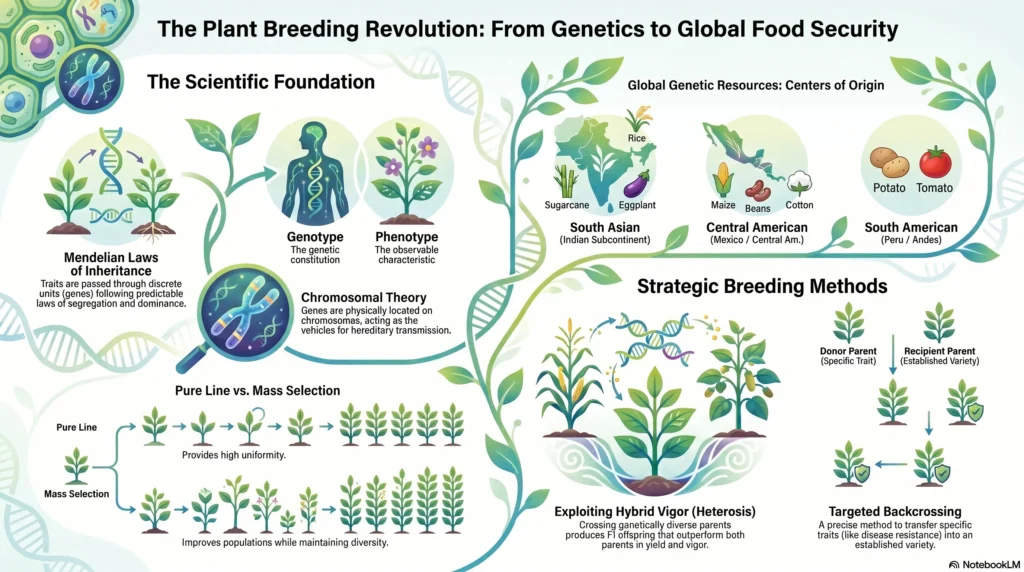
Basics of Plant Breeding: Techniques for the Future of Agriculture is a comprehensive and practical guide designed to introduce students, researchers, academicians, and agricultural professionals to the fundamental and advanced concepts of plant breeding. The book provides a systematic understanding of how scientific breeding methods contribute to crop improvement, food security, and sustainable agricultural development. It combines classical breeding principles with modern molecular and genomic approaches, offering readers a complete overview of the discipline.
Plant breeding has played a vital role in increasing crop productivity, improving quality traits, and developing varieties capable of withstanding biotic and abiotic stresses. As global agriculture faces challenges such as climate change, population growth, diminishing natural resources, and emerging pests and diseases, the need for innovative breeding strategies has become more important than ever. This book explores the scientific foundations of genetics and inheritance while highlighting practical breeding techniques used in major crop improvement programs around the world.
Beginning with the history and evolution of plant breeding, the book explains the principles of genetics that govern trait inheritance and variation. It discusses the importance of genetic resources and germplasm conservation as the backbone of successful breeding programs. Readers are introduced to plant reproductive biology, pollination mechanisms, and hybridization techniques that form the basis of crop improvement efforts.
The book further presents breeding methods for both self-pollinated and cross-pollinated crops, explaining selection procedures, hybrid breeding, and population improvement strategies. Special emphasis is given to mutation breeding and polyploidy, which have contributed significantly to the development of improved crop varieties. Modern breeding technologies such as marker-assisted selection, genomic selection, genetic engineering, and CRISPR-based gene editing are discussed in detail to familiarize readers with cutting-edge developments in the field.
In addition, the book addresses breeding for resistance against diseases, pests, drought, salinity, and other environmental stresses, highlighting the importance of climate-resilient agriculture. The final chapters focus on future perspectives, including precision breeding, artificial intelligence applications, intellectual property rights, farmers’ rights, and participatory breeding approaches.
Written in a clear and student-friendly manner, this book serves as an essential resource for undergraduate and postgraduate students of agriculture, plant breeding, genetics, biotechnology, and allied sciences. It also provides valuable insights for researchers, extension workers, seed industry professionals, and policymakers interested in modern crop improvement. By integrating traditional knowledge with emerging technologies, the book aims to equip readers with the understanding and skills needed to contribute to the future of sustainable agriculture and global food security.
BOOK MAP
CHAPTERS
Chapter 1: Introduction to Plant Breeding
This chapter introduces the origin, development, and significance of plant breeding in agriculture. It explains the objectives of crop improvement and the major challenges faced in developing superior crop varieties.
Chapter 2: Principles of Genetics
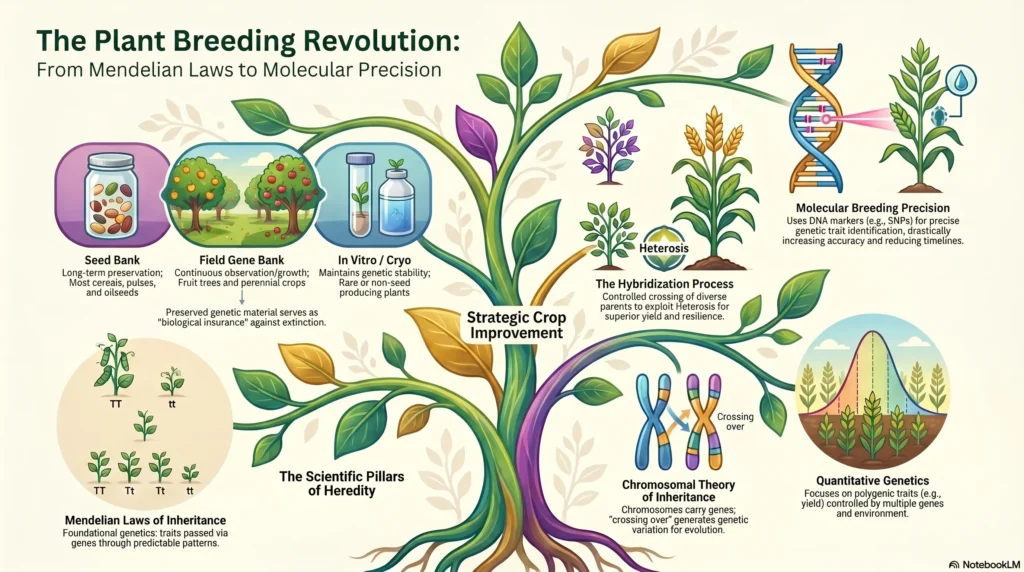
The chapter covers the fundamental laws of inheritance and genetic variation. It provides an understanding of genes, chromosomes, mutations, and quantitative traits that influence plant breeding outcomes.
Chapter 3: Genetic Resources and Germplasm
This chapter highlights the importance of genetic diversity in crop improvement. It discusses germplasm collection, conservation methods, gene banks, and the utilization of genetic resources in breeding programs.
Chapter 4: Plant Reproduction and Pollination
Readers learn about floral biology, reproductive systems, and pollination mechanisms in plants. The chapter also explains hybridization techniques essential for creating new genetic combinations.
Chapter 5: Breeding Methods for Self-Pollinated Crops
This chapter focuses on breeding approaches used in self-pollinated crops. It explains various selection methods and breeding procedures employed to develop pure and stable varieties.
Chapter 6: Breeding Methods for Cross-Pollinated Crops
The chapter explores breeding techniques used in cross-pollinated species. Topics such as heterosis, hybrid development, recurrent selection, and population improvement are discussed in detail.
Chapter 7: Mutation Breeding and Polyploidy
This chapter describes how induced mutations and chromosome manipulations can generate useful genetic variation. It also presents practical applications and success stories of mutation breeding.
Chapter 8: Molecular Breeding Techniques
Modern breeding tools are introduced in this chapter, including DNA markers, genomic selection, genetic engineering, and gene editing technologies. These methods accelerate the development of improved crop varieties.
Chapter 9: Breeding for Stress Resistance
The chapter focuses on breeding crops capable of withstanding diseases, pests, drought, salinity, and other stresses. It emphasizes the importance of climate-resilient cultivars for sustainable agriculture.
Chapter 10: Future Perspectives in Plant Breeding
This chapter examines emerging technologies and future trends shaping plant breeding. It discusses artificial intelligence, precision breeding, regulatory concerns, and the role of innovation in ensuring food security.
Chapter 11: Participatory Plant Breeding
The final chapter highlights the involvement of farmers and stakeholders in crop improvement programs. It also explains variety release procedures, intellectual property rights, and legal frameworks protecting breeders and farmers.