₹ 999.00
$99.00
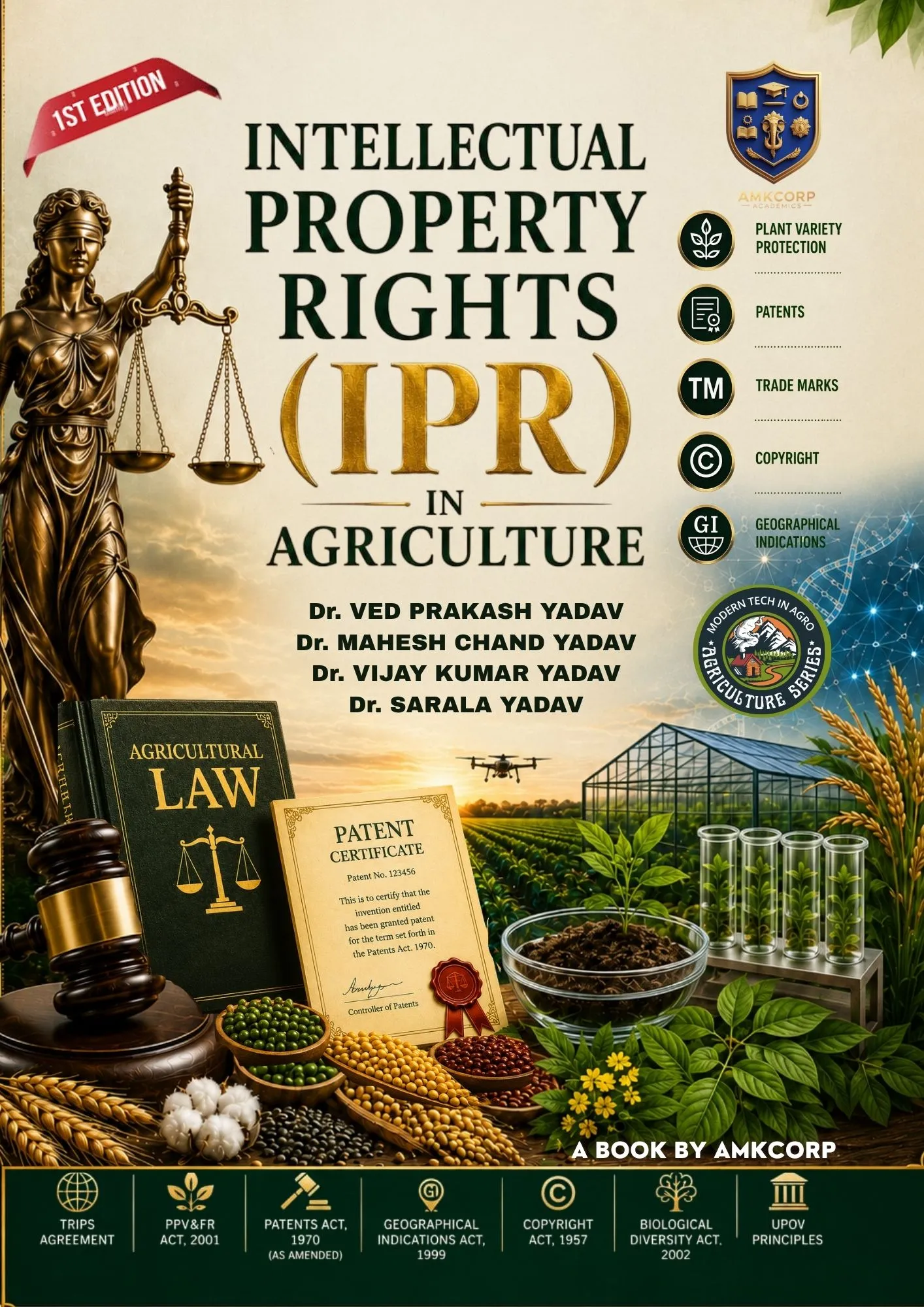
INTELLECTUAL PROPERTY RIGHTS (IPR) IN AGRICULTURE
SCIENCE, INNOVATION AND APPLICATIONS
AUTHOR(S) -
Dr. VED PRAKASH YADAV
Dr. MAHESH CHAND YADAV
Dr. VIJAY KUMAR YADAV
Dr. SARLA YADAV

DOI – 10.61909/AMKEDTB072682
Genre/Subject -Agriculture, Intellectual Property Rights
Book code -AMKEDTB072682
pgs: 246
ISBN(P) -978-93-6556-021-3
ISBN(E) – 978-93-6556-020-6
Published – 09/07/2026
Edition – 1
BUY PRINT

BUY EBOOK
INTRODUCTION VIDEO

AUTHORS

Dr. VED PRAKASH YADAV
Dr. Ved Prakash Yadav is an accomplished agricultural scientist, academician, and researcher specializing in Plant Breeding and Genetics, Seed Science & Technology, Climate-Resilient Agriculture, and Crop Improvement. He is associated with and has contributed significantly to teaching, research, seed production, and technology dissemination in the field of agricultural sciences.
Dr. Yadav possesses extensive experience in crop breeding, varietal development, seed quality enhancement, and sustainable agricultural technologies with special emphasis on arid and semi-arid agro-ecosystems of Rajasthan. His research interests include genetic improvement of field crops, hybrid seed technology, climate-smart agriculture, biofortified crops, germplasm conservation, molecular breeding approaches, and seed system development. He has actively worked on integrating modern breeding tools with practical field applications for enhancing agricultural productivity and farmer resilience under changing climatic conditions.
Throughout his professional career, Dr. Yadav has been actively involved in research projects, seed production programs, farmer-oriented extension activities, and scientific capacity building. He has contributed to multidisciplinary agricultural research initiatives related to crop improvement, stress tolerance, seed vigour enhancement, and sustainable farming systems. His scientific contributions include research papers, review articles, technical bulletins, training manuals, popular articles, and presentations in national and international conferences.
Dr. Yadav has also played an important role in promoting quality seed production, scientific awareness among farmers, and strengthening linkages between research institutions and farming communities. His academic and professional interests extend to agricultural innovation, precision breeding, seed entrepreneurship, and policy-oriented approaches for strengthening India’s seed sector.
As an author and editor, Dr. Ved Prakash Yadav aims to bridge the gap between advanced scientific knowledge and field-level agricultural applications. His vision emphasizes sustainable agriculture, technological innovation, biodiversity conservation, and farmer-centric agricultural development aligned with national priorities of food security and climate resilience.
His continued dedication toward agricultural research, scientific education, and seed technology development reflects a strong commitment to advancing modern agriculture and empowering future generations of agricultural professionals and farmers.

Dr. MAHESH CHAND YADAV
Dr. Mahesh C. Yadav is a prominent Indian agricultural scientist currently serving as a Principal Scientist (Genetics) at the Division of Genomic Resources of the ICAR-National Bureau of Plant Genetic Resources (NBPGR) in New Delhi. Educated from the prestigious Indian Agricultural Research Institute (IARI), New Delhi and obtained Master of Science (M.Sc.) and Doctor of Philosophy (Ph.D.) degrees in Genetics in 1992 and 1998, respectively. He is an eminent Molecular Geneticist with over 30 years of distinguished service in agricultural research, biotechnology, and academic leadership.
Throughout a brilliant academic and professional career, he has driven pioneering advancements in molecular genetics, pre-breeding, and DNA barcoding across major field crops and fungi, including rice, wheat, maize, and mushrooms. Deputed for foreign training under NATP project at HRI, United Kingdom (2002), and undergone advanced trainings (1999) in the world-renowned Labs in Biotechnology like CCMB and CDFD, Hyderabad and ICGEB, New Delhi.He is credited with establishing the first Biotechnology Lab at the ICAR-Directorate of Mushroom Research (DMR), Solan, and has successfully led crucial national genomic initiatives, including serving as the Head of the Division of Genomic Resources at ICAR-NBPGR (2022–2023).At ICAR-NBPGR, the key projects led by him include ICAR mega-Network Project NICRAfocused on collecting and identifying climate-smart germplasm for rice and wheat.
His group focuses on pre-breeding strategies to build genetic tolerance against abiotic stresses like heat, salinity, and drought. He has successfully developed DNA barcodes for cultivated and wild rice (Oryza species) and Luffa species to aid in genetic identification and conservation. In wheat breeding,his group is recognized for identifying numerous QTLs and QTNs controlling grain size and stress tolerances in bread wheat. He has developed the multi-parent (5-parent and 8-parent) MAGIC populations in bread wheat. Dr. Yadav has made significant contribution in teaching and research guidance, and guided 7 Ph.D. and 3 M.Sc. students in PGR/Biotechnology, and supervised the Research Project Work (3-6 months)of 29 M. Sc. (Biotechnology) and 5 students of B.Tech./B.Sc., published 75 research papers in high impact national and international journals, written 15 book chapters, edited 2 books and conference proceedings, and presented oral and lead-papers at various national and international fora.

Prof. VIJAY K. YADAV
Prof. (Dr.) Vijay Kumar Yadav obtained his B.Sc. (Ag & AH) (1988), M.Sc. Ag, Genetics & Plant Breeding (1990) and Ph.D.(1998) degree from C.S.A University of Agriculture and Technology, Kanpur-2 and, Serving this university since 1998 as Assistant Professor to Professor cum Sr. Wheat breeder from 2013 till date. He has more than 28 years’ experience of teaching, research and extension and, wide foreign exposure notably worked as International Rice Breeder in FAO of United Nations, DPR Korea; trained at International Rice Research Institute, Philippines Thailand. Dr Yadav had identified, released and registered more than one dozen of barley, wheat and rice crop varieties; handled 10 national and international research project including two centre of excellence on wheat and millets as Principal Investigator.
Dr. Yadav guided 29 students of PG and 06 of Ph.D. as major guide and, credited to publish 10 books notably Pulse crops- Production Technology; Agro-Techniques of Cereal Crops; GENERAL AGRICULTURE, two coffee table book, five proceedings Souvenir and Technical Recommendations; Eight technical bulletins; 15 book chapters, and published more than 200 research/ presented papers/ popular articles in various national and international reputed journals.
Dr Yadav recipient of Vishistha Vaigiyanic Puruskar, Harit Puruskar , Best Scientist Award, Distinguished Scientist Award, Best Innovator of the university Award Fellowship Awards, Korona Yoddha award by various organizations and Best AICRP on rice Centre award from ICAR .He credited to organize 42 national and international seminar, symposium, conference and congress as a various capacity remarkably 4th Agricultural Science Congress, International Conference on SSADCCC&AE, National WEBCON as Organizing Secretary.
He is served the university as Director-Research, Joint Director- Research, Professor & Head of Department of Agri -Business Management Director of Placement, Head of Department of University Engineering., President, University Games, Game Councillor for Hockey, Kabaddi and Kho-Kho and currently serving as Director Seed &Farm, Professor & Head, GPB, Director Placement, Director IQAC-International, Professor cum Sr. Wheat Breeder, Head of Section of Rabi Cereals, Nodal officer, seed and Referral Molecular lab and Coordinator PGD on Agri Journalism & Communication Science and five university cells.

Dr. SARALA YADAV
Dr. (Mrs.) Sarala Yadav is a Senior scientist in the Division of Crop Improvement and Seed Technology, ICAR – Central Potato Research Institute, Regional Station, Patna, Bihar – 801506. Dr Yadav obtained her doctoral degree in Genetics and Plant Breeding from Institute of Agricultural Sciences, Banaras Hindu University, Varanasi, UP, and started her carrier as Scientist in the Division of Seed Science and Technology. Indian Agricultural Research Institute, New Delhi during the year, 2010. Later she joined ICAR-CPRI RS, Patna as Scientist senior scale in 2015. Her major field of interest are Potato breeding, clonal evaluation, performance evaluation, Germplasm management and conservation. She is actively involved in development of red and purple skinned potato varieties with high dry matter content suitable for cultivation in Eastern Indo- Gangetic plains of India, development and promotion of nutritionally superior potato varieties and true potato seed population development.
She has also developed, screened and introduced six Potato advanced clones suitable for cultivation in Eastern plains. Dr Yadav was honoured with ‘Women Scientist Award’ by the Scientific and educational Research Society, Meerut, UP and G.B.P.U.A.&T., Pantnagar, UK, India for outstanding research in Genetics and Plant breeding (2018-2023). She is fellow of Indian Society of Seed Technology, New Delhi and Society of Upliftment of Rural Economy, Varanasi. Dr Yadav has over hundred research papers, technical and popular articles, book chapters, technical bulletins to her credit. She is serving IPA as counsellor (Region-V).
ABOUT BOOK / ABSTRACT
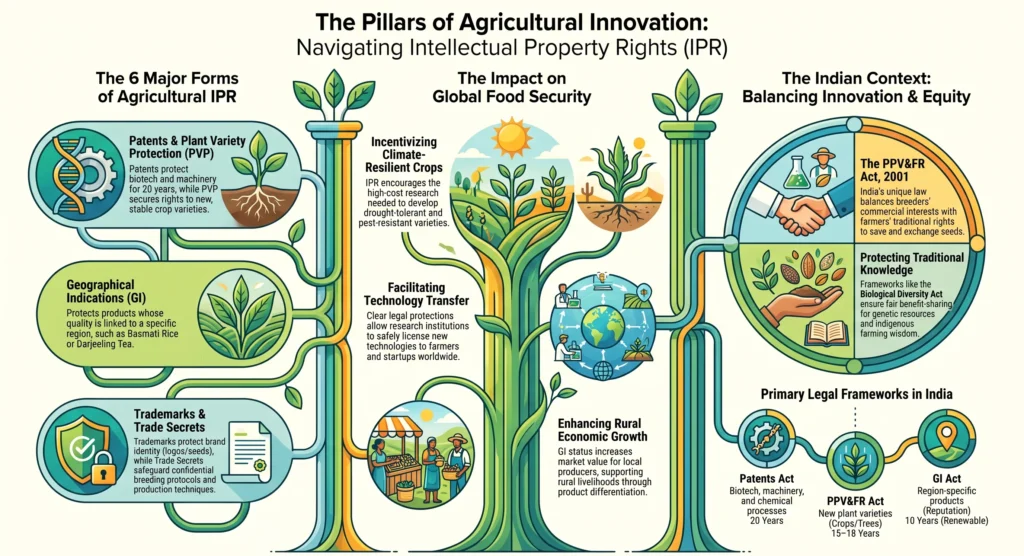
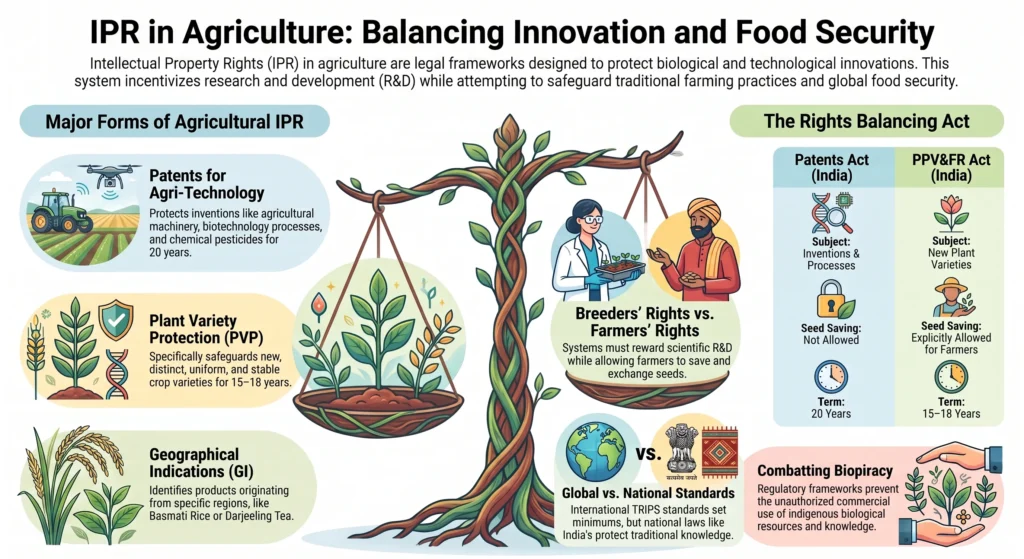
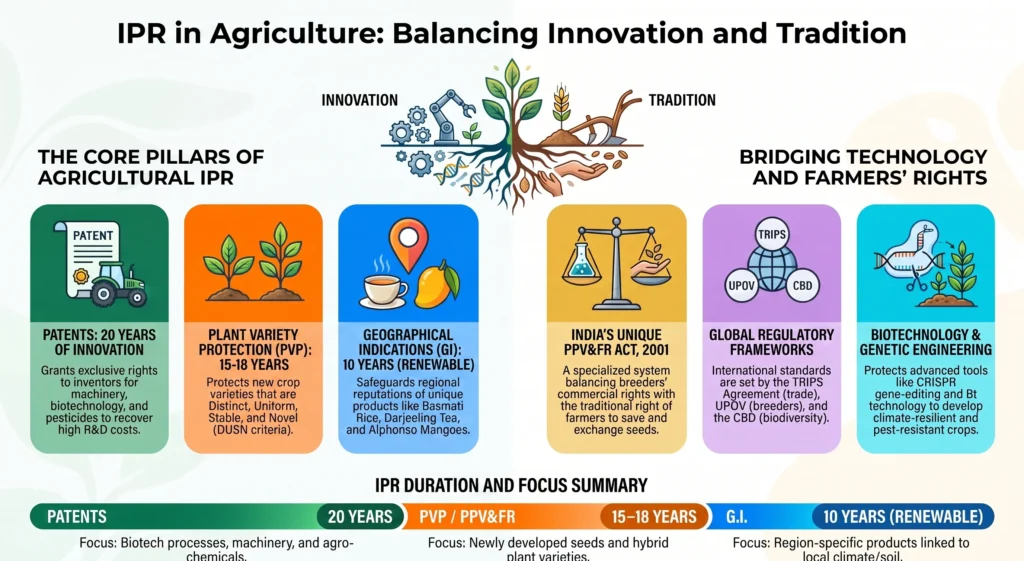
Intellectual Property Rights (IPR) in Agriculture provides a structured overview of the principles, forms, applications, and challenges of intellectual property protection within the agricultural sector. The book begins with the concept and historical development of IPR and explains its importance, scope, objectives, and global relevance in agriculture. It then introduces major forms of intellectual property protection, including patents, trademarks, copyrights, geographical indications, and plant variety protection.
A major focus of the book is the relationship between intellectual property and agricultural innovation. It discusses patentability criteria, agricultural biotechnology patents, the protection of seeds and plant genes, patent application procedures, and the challenges associated with agricultural patenting. The book also examines plant variety protection, farmers’ rights, breeders’ rights, and the role of plant variety protection in agricultural development.
The book further explores geographical indications and their significance for agricultural products, including registration, economic benefits, and implementation challenges. Agricultural biotechnology is addressed through discussions on genetic engineering, protection of genetically modified crops, biotechnology patents, food security, and associated ethical issues.
An international perspective is developed through coverage of WIPO, the TRIPS Agreement, the UPOV Convention, the Convention on Biological Diversity, and other international treaties affecting agricultural intellectual property. The later chapters connect IPR with sustainable agricultural development, technology transfer, research incentives, rural development, and sustainable agriculture policies. The book also addresses practical and policy challenges such as farmers’ access to technology, biopiracy, traditional knowledge, seed ownership, regulatory issues, and the balance between innovation and public interest. Finally, it considers emerging trends, digital agriculture, policy recommendations, future challenges, and opportunities, providing a concluding perspective on the evolving role of IPR in agriculture.
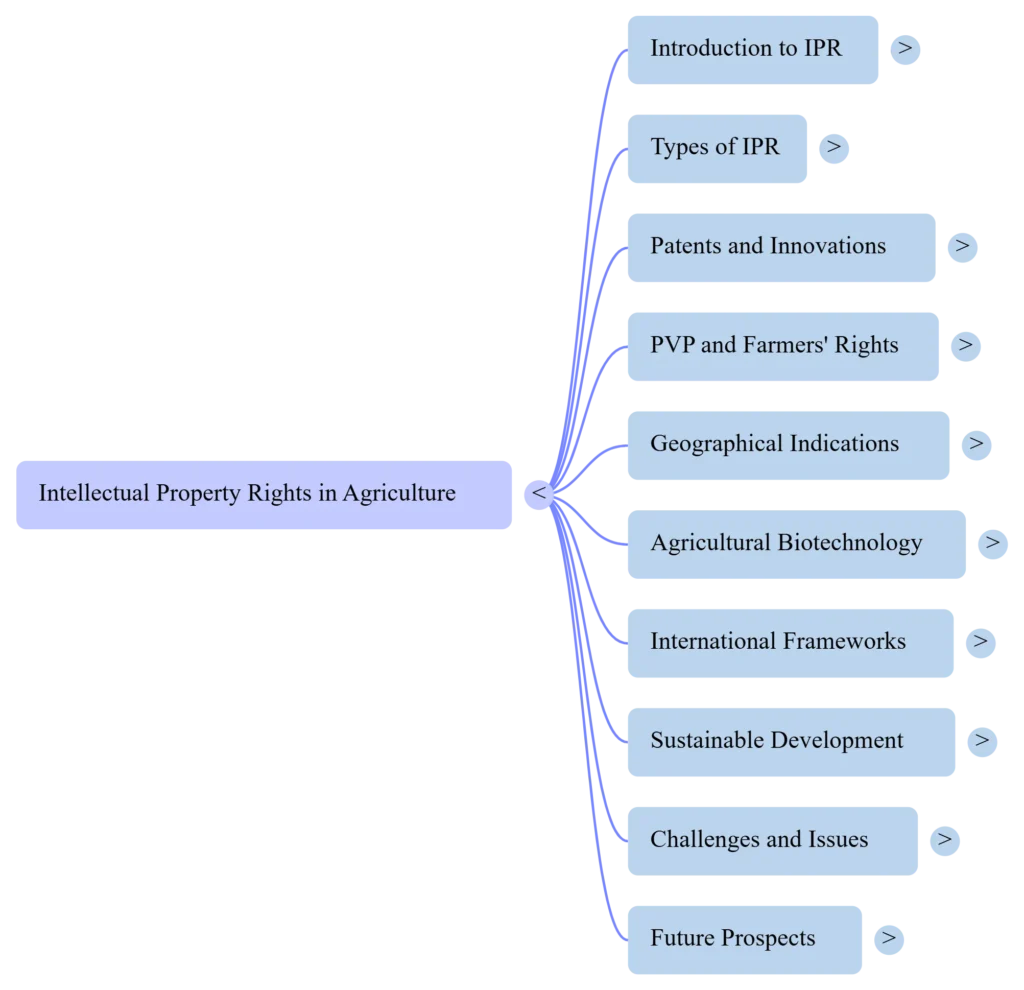
BOOK MAP
CHAPTERS
Chapter 1: Introduction to Intellectual Property Rights in Agriculture
Introduces the concept, historical development, importance, scope, and objectives of IPR in agriculture. It also presents the global perspective of agricultural intellectual property rights.
Chapter 2: Types of Intellectual Property Rights in Agriculture
Explains the principal forms of agricultural IPR, including patents, trademarks, copyrights, geographical indications, and plant variety protection. It establishes the basic framework for understanding their agricultural applications.
Chapter 3: Patents and Agricultural Innovations
Examines patentability criteria and the protection of agricultural innovations, biotechnology, seeds, and plant genes. It also outlines the patent application process and major challenges in agricultural patenting.
Chapter 4: Plant Variety Protection and Farmers’ Rights
Discusses the concept and protection of new plant varieties along with farmers’ rights under IPR laws. It also considers breeders’ rights and responsibilities and the contribution of PVP to agricultural development.
Chapter 5: Geographical Indications in Agriculture
Explains the meaning, significance, and registration of geographical indications in agriculture. The chapter also covers protected agricultural products, economic benefits, and challenges in GI implementation.
Chapter 6: Intellectual Property Rights and Agricultural Biotechnology
Explores the relationship between biotechnology, genetic engineering, and intellectual property protection. It addresses genetically modified crops, biotechnology patents, food security, and ethical issues in agricultural biotechnology.
Chapter 7: International Frameworks Governing Agricultural IPR
Introduces major international frameworks relevant to agricultural IPR, including WIPO, TRIPS, UPOV, and the Convention on Biological Diversity. It examines how international treaties influence agricultural intellectual property.
Chapter 8: IPR and Sustainable Agricultural Development
Examines the role of IPR in agricultural growth, technology transfer, research incentives, and rural development. It also considers the relationship between IPR systems and sustainable agriculture policies.
Chapter 9: Challenges and Issues in Agricultural IPR
Addresses key challenges including farmers’ access to technology, biopiracy, traditional knowledge, seed ownership, and legal and regulatory concerns. It concludes by examining the balance between innovation and public interest.
Chapter 10: Future Prospects and Conclusion
Discusses emerging trends in agricultural IPR, including digital agriculture, and presents policy recommendations. It concludes by identifying future challenges and opportunities for intellectual property in agriculture.