₹ 999.00
$99.00
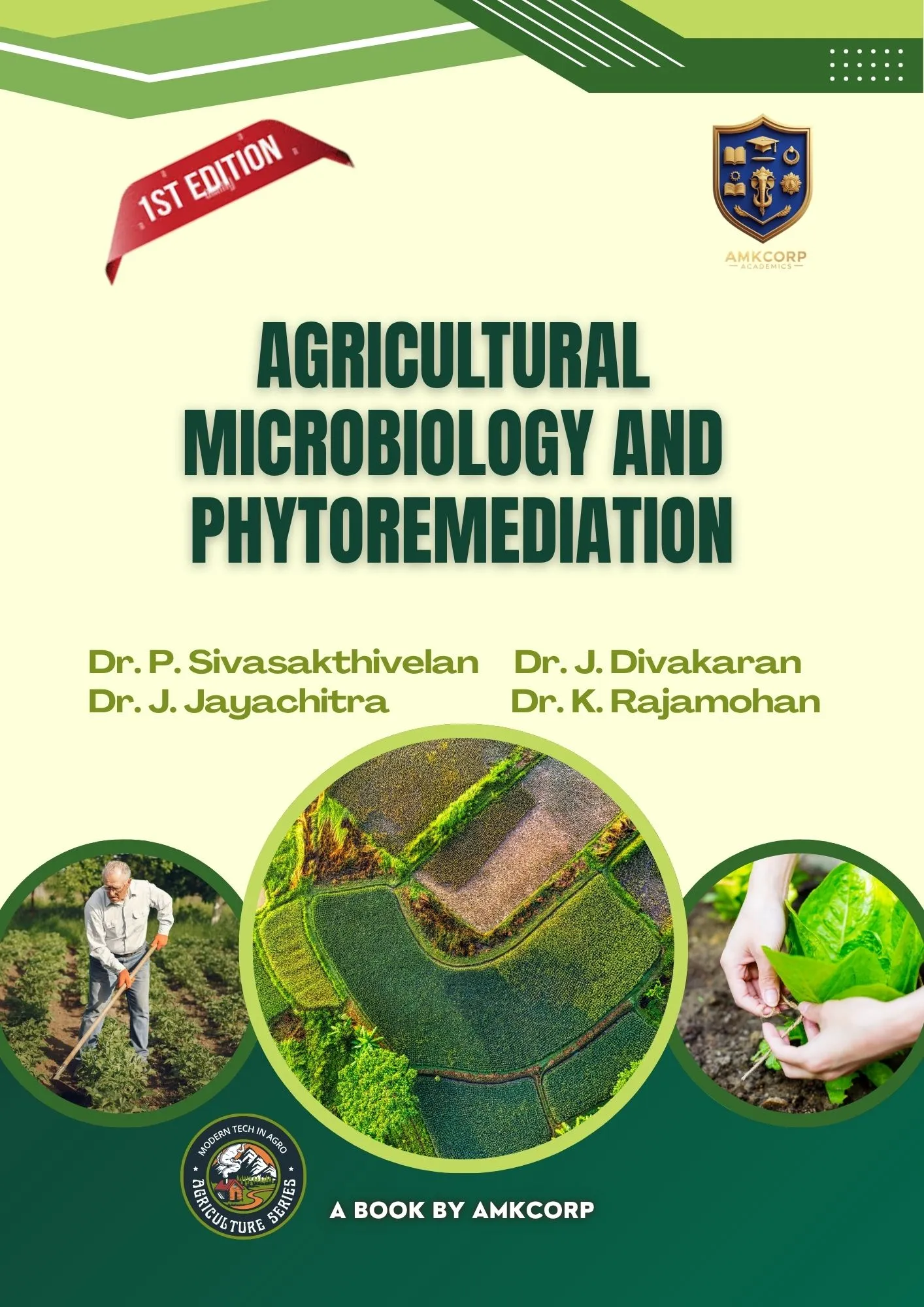
AGRICULTURAL MICROBIOLOGY AND PHYTOREMEDIATION
AUTHOR(S) -
Dr. P. SIVASAKTHIVELAN, Dr. J. DIVAKARAN,
Dr. J. JAYACHITRA, Dr. K. RAJAMOHAN

DOI – 10.61909/AMKEDTB032660
Genre/Subject – Agriculture, Microbiology
Book code – AMKEDTB032660 pgs: 241
ISBN(P) -978-93-6556-275-0
ISBN(E) – 978-93-6556-730-4
Published – 23/03/2026
Edition – 1
BUY PRINT

BUY EBOOK
INTRODUCTION VIDEO

AUTHORS

Dr. P. SIVASAKTHIVELAN
Dr. P. Sivasakthivelan currently serves as Assistant Professor in Agricultural Microbiologyat Tamil Nadu Agricultural University, Sugarcane Research Station, Cuddalore. He has been awarded with 4 university gold medals for these outstanding academic accomplishments; he brings 18 years of teaching excellence and research contributions. His academic outreach includes 26 international and 67 national conference presentations, organization of 16 academic events, 32 invited lectures across state institutions, and participation in 28 national workshops and 19 training programs. His prolific scholarly output features 18 authored books, 20 edited volumes, and 36 chapters with premier publishers including Springer, Elsevier, CRC Press, and Taylor & Francis. He boasts 104 peer-reviewed international publications, reflected in a Google Scholar citation count of 1275, h-index of 20, and i10-index of 37. Dr. Sivasakthivelan has mentored 17 postgraduate research scholars and 2 Ph.D. candidates, while leading consultancy projects and securing funding from TNSCST and TANSCHE. His innovative impact extends to 3 international patents (Australia, Germany, UK) and 4 Indian patents, earning him prestigious fellowships as Associate Fellow of the Society for Nature and Applied Sciences (AFSNAS) and Fellow of Bose Science Society (FBSS) from the Tamil Nadu Scientific Research Organisation (TNSRO).

Dr. J. DIVAKARAN
Dr. J. Divakaran earned his basic and master’s degrees from Annamalai University (1989-1995) and obtained his Ph.D. in Agricultural Microbiology from the same institution, where he now serves as Associate Professor. Specializing in microbial management of agricultural waste, he delivers innovative, need-based solutions for waste disposal and recycling, while teaching undergraduate and postgraduate courses in Soil Microbiology and Environmental Science. Over 23 years, he has successfully guided numerous master’s and doctoral students, actively presented at national and international conferences, and published impactful research papers in peer-reviewed international journals.

Dr. J. JAYACHITRA
Dr. J. Jayachitra is an esteemed academician with over 20 years of dedicated teaching and research experience in Agricultural Microbiology. She earned her B.Sc. in Agriculture, M.Sc., and Ph.D. in Agricultural Microbiology from the Department of Agricultural Microbiology, Faculty of Agriculture, Annamalai University. Since 2006, she has served as Assistant Professor, contributing significantly to the department’s academic and research endeavors.
Her areas of specialization include Biofertilizer Technology and Food Microbiology. Over the past two decades, Dr. Jayachitra has handled key undergraduate and postgraduate courses such as Fundamentals of Microbiology, Environmental Microbiology, Food Microbiology, Agricultural Microbiology, Microbial Genetics, and Microbial Physiology. Her commitment to mentorship is evident in guiding research scholars: 1 Ph.D. in Agricultural Microbiology, 2 M.Phil. in Microbiology, 7 M.Sc. in Agricultural Microbiology, and 10 M.Sc. in Microbiology students.
Dr. Jayachitra has actively participated in several National and International Conferences across the state, fostering knowledge exchange in her field. She has an impressive publication record, with several research papers in peer-reviewed international journals, advancing sustainable agricultural practices through bio fertilizer innovations and microbial applications.

Dr. K. RAJAMOHAN
Dr. K. Rajamohan, M.Sc. (Agri.), Ph.D., serves as Assistant Professor in the Department of Pathology at Sugarcane Research Station, Cuddalore, under Tamil Nadu Agricultural University. With 21 years of dedicated teaching and 23 years of pioneering research, he specializes in biological control strategies for managing soil-borne diseases, driving sustainable agricultural solutions. His mentorship excellence shines through guiding 3 Ph.D. scholars to completion and 11 M.Sc. (Agri.) students, complemented by an outstanding publication portfolio of 30 international and 5 national papers, including high-impact 2025 articles in Springer and Elsevier journals on Fusarium wilt pathogens and Bacillus-based antifungals. Dr. Rajamohan leads transformative research as Principal Investigator in All India Coordinated Research Projects targeting sugarcane diseases—Red Rot, Smut, Wilt, Pokka Boing, and Yellow Leaf. A prolific academic leader, he has organized symposia, presented at 7 international and 22 national conferences, and earned Best Teacher, Researcher, and Publication Awards.
ABOUT BOOK / ABSTRACT
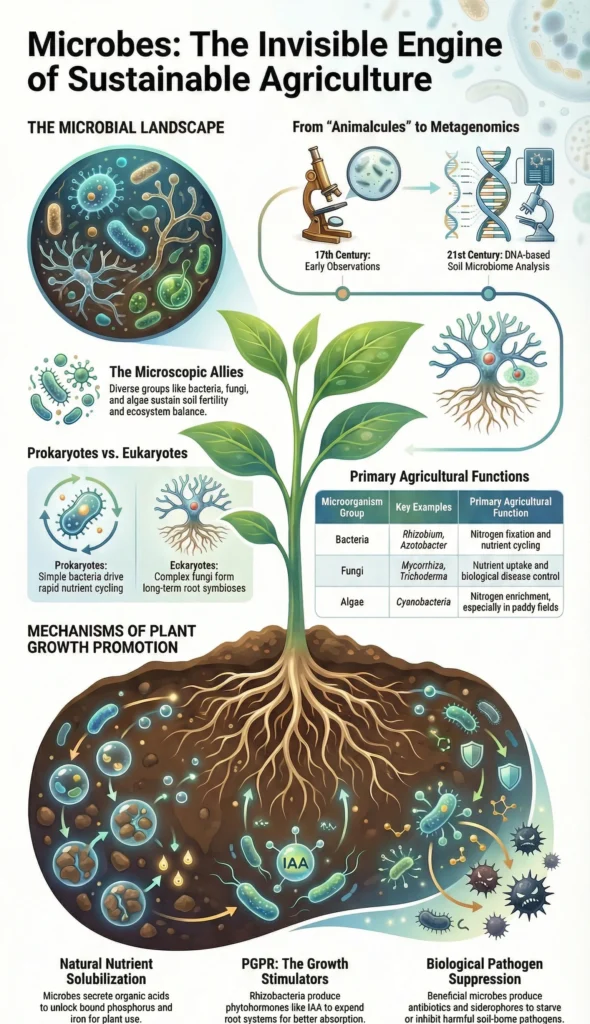
Agricultural Microbiology and Phytoremediation is a comprehensive and thoughtfully structured textbook designed to provide students, researchers, and agricultural professionals with a deep understanding of the microbial world and its profound impact on agriculture and environmental sustainability. This book bridges classical microbiological concepts with modern applications, presenting an integrated perspective on how microorganisms influence soil fertility, plant health, crop productivity, and ecological balance.
The book begins by laying a strong foundation in the basic principles of microbiology, exploring the historical development of the field and the major discoveries that shaped modern agricultural science. It gradually expands into microbial diversity, classification systems, and cell structure, enabling readers to understand the complexity and functional significance of bacteria, fungi, viruses, and other microorganisms in agricultural ecosystems. Clear explanations of microbial physiology, nutrition, metabolism, and genetics help readers appreciate how microorganisms grow, reproduce, and adapt to various environmental conditions.
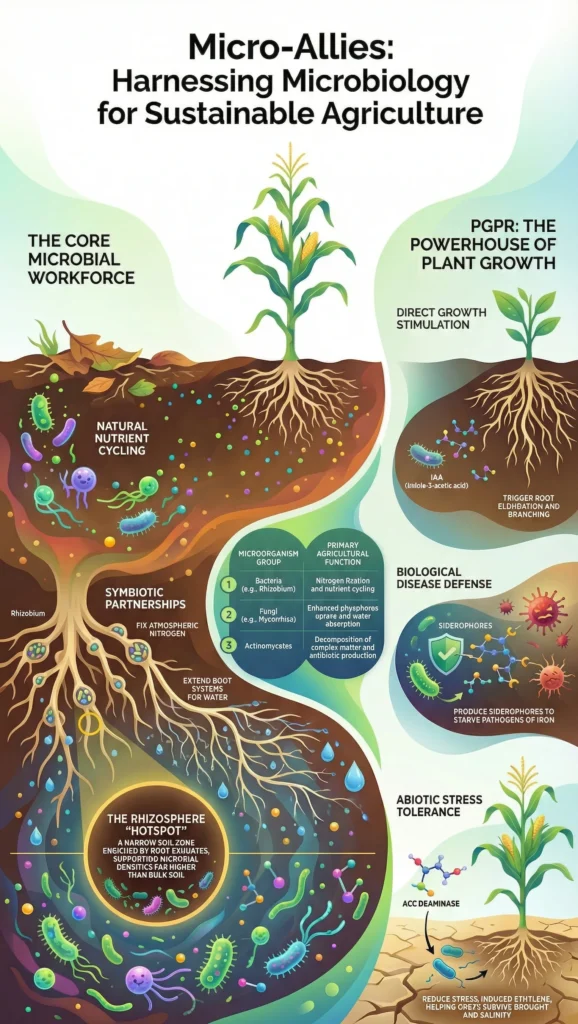
A significant portion of the book focuses on soil microbiology and plant–microbe interactions, highlighting the dynamic relationship between roots and microorganisms in the rhizosphere. The text explains how beneficial microbes contribute to nutrient cycling, organic matter decomposition, nitrogen fixation, and solubilization of essential minerals such as phosphorus and zinc. The role of Plant Growth Promoting Rhizobacteria (PGPR) is discussed in detail, emphasizing their importance in sustainable agriculture and soil health improvement.
The book also addresses plant diseases and biological control strategies, offering insights into microbial pathogens, disease management principles, and the use of biocontrol agents and biopesticides as eco-friendly alternatives to chemical pesticides. In addition, readers are introduced to environmental and industrial microbiology, including fermentation technology, waste degradation, biogas production, and biodegradable plastics—demonstrating how microorganisms contribute to both agriculture and industry.
Food and water microbiology chapters emphasize food safety, preservation methods, waterborne pathogens, and microbial analysis techniques, ensuring a practical understanding of public health aspects. The section on laboratory techniques provides detailed knowledge of sterilization, culture media preparation, microscopy, isolation, and preservation of microorganisms, making the book suitable for academic coursework and laboratory training.
The final chapter focuses on bioremediation and phytoremediation, presenting innovative approaches to managing polluted soils using microbes and plants. It discusses recent advances in agricultural microbiology and outlines future prospects and challenges in the field. By combining theoretical concepts with practical applications, this book serves as a valuable academic resource and a guide for sustainable agricultural development.
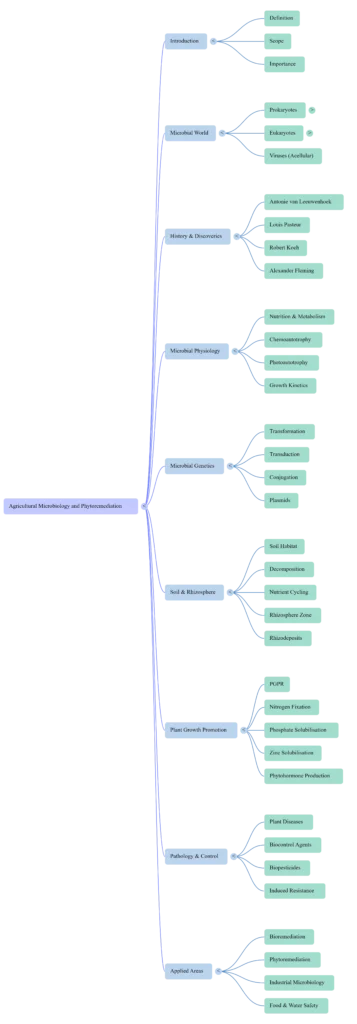
BOOK MAP
CHAPTERS
Chapter 1: Introduction to Agricultural Microbiology
This chapter introduces the basic concepts, scope, and historical development of microbiology. It explains the importance of microorganisms in agriculture and highlights their applied roles in crop production and soil management.
Chapter 2: Microbial Classification and Diversity
This chapter discusses principles of microbial taxonomy, classification systems, and diversity among bacteria, fungi, and viruses. It also introduces modern molecular tools used for microbial identification.
Chapter 3: Microbial Cell Structure and Function
This chapter explains the structural organization of bacterial, fungal, and viral cells. It compares prokaryotic and eukaryotic cells and describes microbial growth and reproduction processes.
Chapter 4: Microbial Physiology and Genetics
This chapter focuses on microbial nutrition, metabolism, growth kinetics, and genetic mechanisms. It also covers plasmids and the basics of genetic engineering in microorganisms.
Chapter 5: Soil Microbiology
This chapter explores soil as a living ecosystem rich in microbial diversity. It explains decomposition, nutrient cycling, and environmental factors influencing soil microbial activity.
Chapter 6: Rhizosphere and Plant–Microbe Interactions
This chapter highlights the concept of the rhizosphere and its significance in plant nutrition. It discusses symbiotic associations, endophytes, and mechanisms of plant–microbe interactions.
Chapter 7: Plant Growth Promoting Microorganisms
This chapter describes PGPR and other beneficial microbes that enhance plant growth. It explains nitrogen fixation, mineral solubilization, and the role of microbes in sustainable agriculture.
Chapter 8: Plant Diseases and Biological Control
This chapter examines plant pathogens and disease management strategies. It emphasizes biological control agents and microbial biopesticides as eco-friendly solutions.
Chapter 9: Environmental and Industrial Microbiology
This chapter discusses environmental functions of microbes and their industrial applications. It covers fermentation, biogas production, biodegradable plastics, and waste degradation.
Chapter 10: Food and Water Microbiology
This chapter focuses on food spoilage organisms, preservation methods, food safety, and waterborne pathogens. It also introduces microbial testing and water purification techniques.
Chapter 11: Techniques in Agricultural Microbiology
This chapter provides practical knowledge of laboratory techniques including sterilization, culturing, microscopy, and microbial preservation methods.
Chapter 12: Bioremediation and Recent Advances
This chapter explains microbial and plant-based remediation of polluted soils. It discusses recent innovations, future prospects, and challenges in agricultural microbiology.