₹ 999.00
$99.00
AI AND THE FUTURE OF SOCIAL WORK
OPPORTUNITIES AND CHALLENGES
AUTHOR(S) -
Dr. SATYENDRA SINGH CHAUHAN, Dr. URVASHI, Dr. RAJESH KUSHWAHA, MANISH KUMAR
DOI – 10.61909/AMKEDTB122549
Genre/Subject – AI, Social Work, Social Science
Book code – AMKEDTB122549 pgs: 265
ISBN(P) – 978-93-6556-557-7
Published – 15/12/2025
ISBN(E) -978-93-6556-836-3
Published – 15/12/2025
Edition – 1
AUTHOR(S)
Dr. SATYENDRA SINGH CHAUHAN
Dr. Satyendra Singh Chauhan is an accomplished academic and development practitioner with more than fifteen years of experience in Social Work, Corporate Social Responsibility (CSR), and community development. He holds a master’s degree, NET and Ph.D. in Social Work and currently serves as an Assistant Professor at CSJM University, Kanpur.
Dr. Chauhan has collaborated extensively with corporates, NGOs, and state governments on initiatives related to primary education, skill development, health, rural development, and social inclusion. His field experience spans the design and execution of high-impact CSR projects aimed at improving the lives of marginalized communities.
In addition to his academic and field contributions, Dr. Chauhan is actively engaged in exploring the role of Artificial Intelligence in Social Sciences, particularly in improving social research methods, predictive analytics for community needs, AI-driven educational tools, and technology-enabled governance. His work emphasizes the ethical and inclusive use of AI to strengthen evidence-based policymaking and social sector interventions.
He has presented research at national seminars, developed teaching resources, and contributed to contemporary debates on Panchayati Raj institutions, labour welfare, social policy, and sustainable development. His professional journey reflects a commitment to integrating research, field practice, community engagement, and emerging technologies to drive systemic and transformative change.
Dr. URVASHI
Dr. Urvashi is an accomplished academician and researcher serving as an Assistant Professor in the Department of Social Work at Chhatrapati Shahu Ji Maharaj University, Kanpur. With over 13 years of teaching experience, she has made significant contributions to social work education, research, and professional training. She earned her Ph.D from IGNOU, M.Phil.from the University of Lucknow, where she specialized in Social Work with a strong focus on Human Resource Management, Health, and Hygiene.
Her academic journey is distinguished by her commitment to integrating theory with field practice. She has actively engaged in research, classroom instruction, and community-based interventions aimed at improving health awareness, organizational well-being, and social development. Her areas of interest include health and hygiene practices, workplace well-being, gender issues, community development, and human resource dynamics.
Dr. Urvashi is also a dedicated member of several prestigious professional bodies, demonstrating her active engagement with the wider academic and social work community. Her memberships include:
National Association of Professional Social Workers in India (NAPSWI)
All India Association of Medical Social Work Professionals (AIAMSWP)
Indian Social Work Congress (NAPSWI)
Rehabilitation Council of India (RCI)
These affiliations reflect her commitment to staying connected with national-level dialogues, advancements, and professional standards within the field of social work.
Dr. RAJESH KUSHWAHA
Dr. Rajesh Kushwaha, started his career as a guest faculty in the Department of Social Work, University of Lucknow, wherein he has been teaching the undergraduate and post graduate students. He also taught as a lecturer in Rajeev Gandhi P. G. College, Kotawa, Jamunipur, Allahabad. Dr. Kushwaha also taught as an assistant professor in the department of Social Work, Dr. B. R. institute of social sciences, Bundelkhand University, Jhansi. Now he is a Senior Assistant Professor in the deptt. Of Social Work, Institute of Social Sciences, Dr. B. R. Ambedkar University, Agra. He has done his Ph. D. from University of Lucknow. He also qualified NET exam in the year 2004 and year 2007. He has published more than 10 books and one dozens articles and research papers in reputed journals of the country. His core area of interests is Social Work, Human Development, Social Legislation and Social Security, Community Organization and Human Resource Management.
MANISH KUMAR
Manish Kumar is an Assistant Professor in the Department of Social Work at Jagadguru Rambhadracharya Divyang State University (JRDSU), Chitrakoot, Uttar Pradesh, India. His teaching and research interests centre on disability studies, accessibility and inclusion in higher education, social policy, and community development in the Indian context. He works extensively on issues faced by students with visual disabilities, focusing on assistive technologies, universal design, and institutional support systems that enable equitable participation in academic life. In addition to classroom teaching, he is actively involved in organising seminars, workshops, and field-based learning initiatives that connect students with communities and policy processes. He has contributed to curriculum development and collaborative projects that promote rights-based, evidence-informed social work practice. His long-term commitment is to strengthen inclusive and accessible higher education ecosystems in India through research, advocacy, and partnerships with universities, government agencies, and civil society organisations. He also mentors young scholars interested in disability-inclusive research and practice.
ABOUT BOOK / ABSTRACT
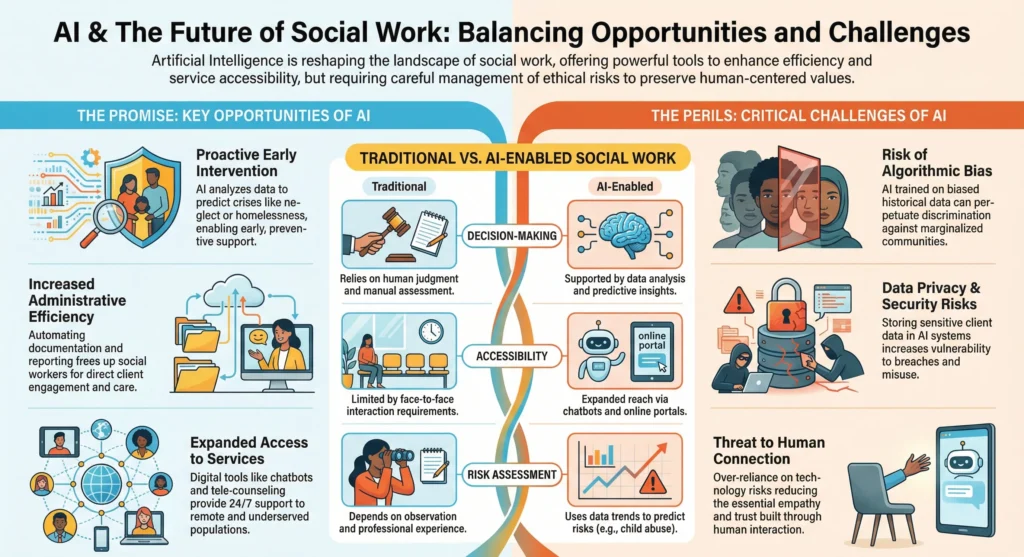
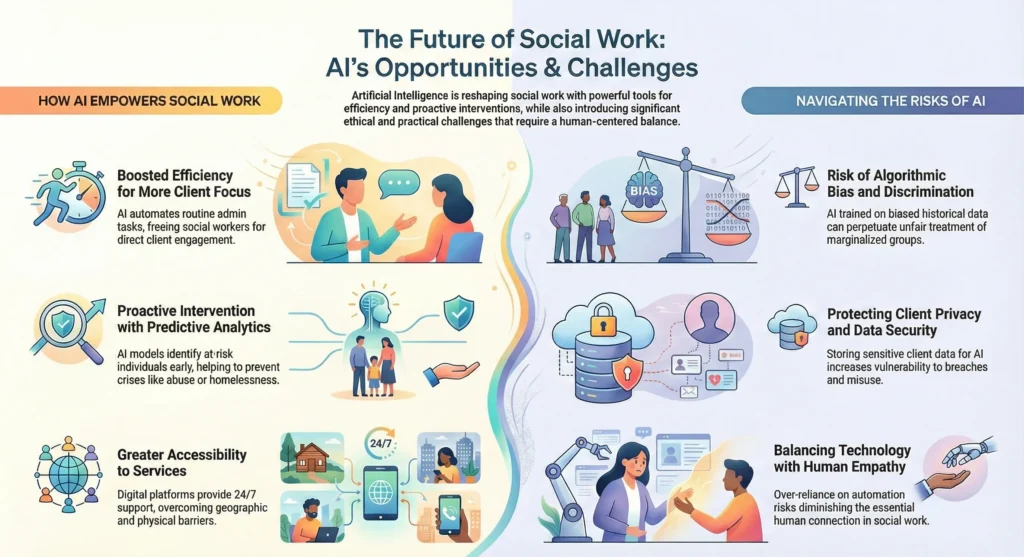
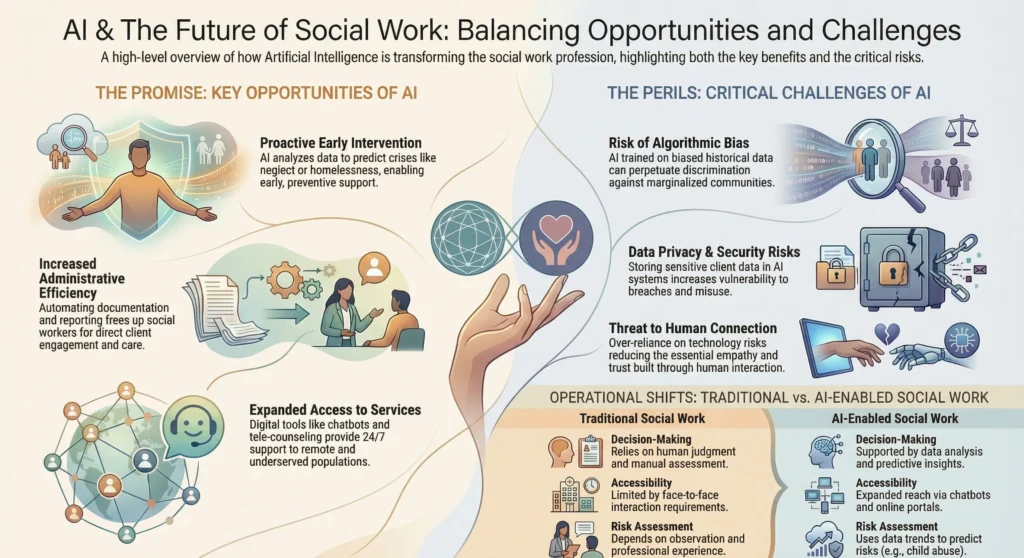
AI AND THE FUTURE OF SOCIAL WORK is a timely and comprehensive exploration of how artificial intelligence is reshaping the practice, ethics, and future of social work across the globe. As digital technologies increasingly influence public services, social workers find themselves at the intersection of human care and machine intelligence. This book provides a thoughtful, human-centered guide to understanding, adopting, and critically engaging with AI tools in social welfare, mental health, community development, and public policy contexts. Written for students, educators, practitioners, administrators, and policymakers, it balances technical understanding with ethical reflection and practical application.
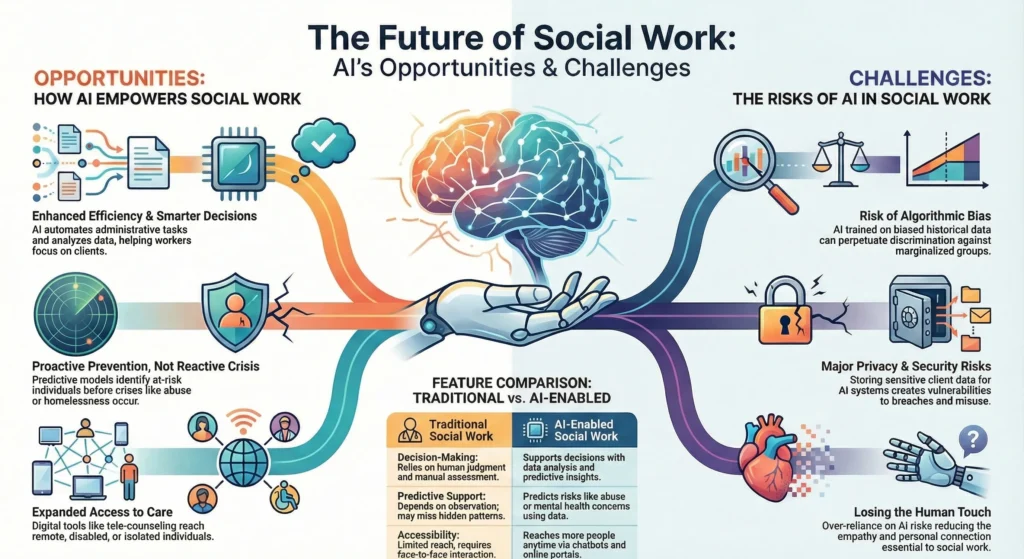
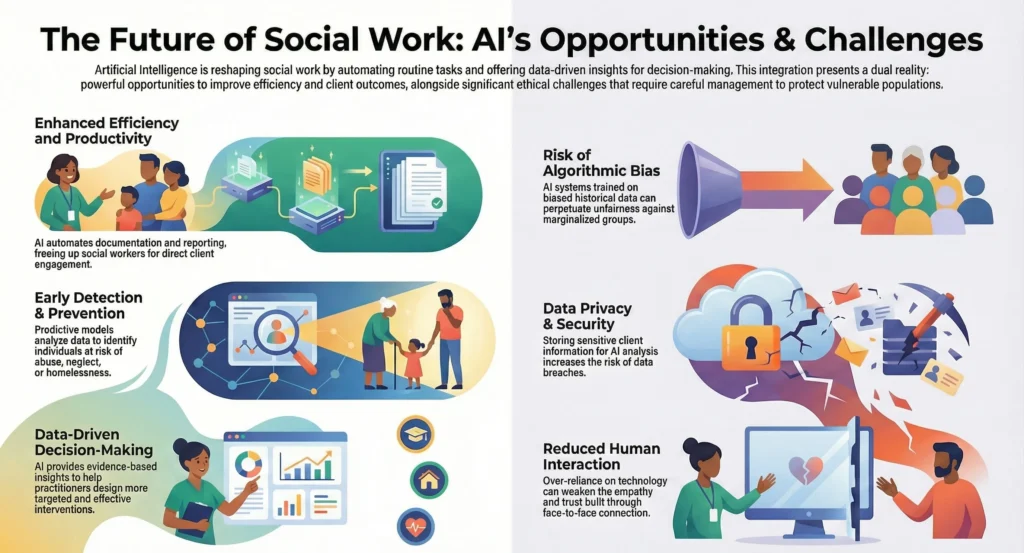
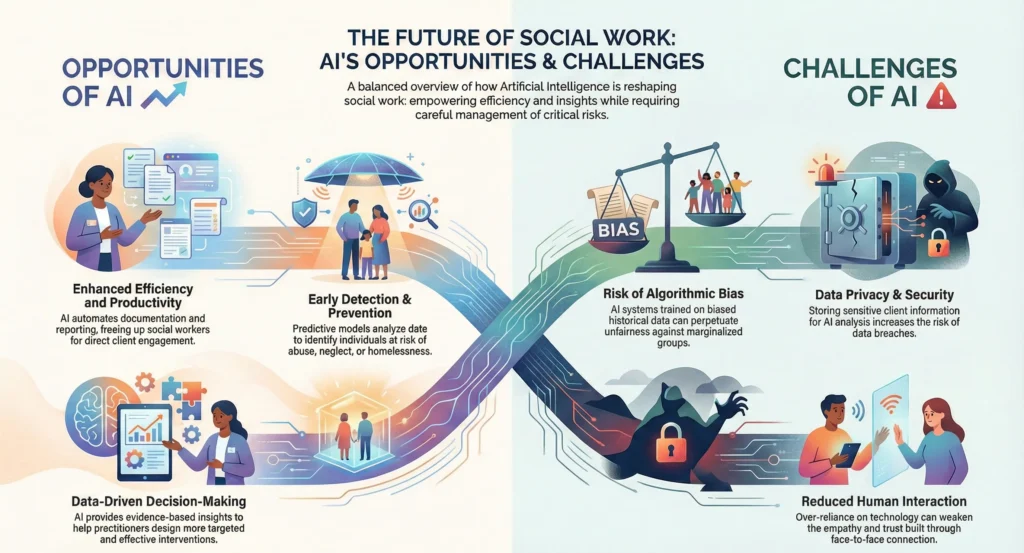
The book begins by situating AI within the broader digital revolution in human services, tracing how social work has evolved from manual, relationship-based practices to data-informed and technology-supported systems. It explains core AI concepts—such as machine learning, natural language processing, and predictive analytics—in accessible language, ensuring that readers without a technical background can build strong AI literacy. Throughout the text, AI is framed not as a replacement for human judgment and empathy, but as a tool that can augment decision-making, enhance early intervention, and improve service efficiency when used responsibly.
A central theme of the book is ethics, fairness, and human dignity. It critically examines issues of data privacy, consent, algorithmic bias, transparency, and accountability, emphasizing the unique ethical responsibilities of social workers when working with vulnerable populations. Real-world case studies and global examples illustrate both the promise and the risks of AI adoption, highlighting lessons learned from successful and problematic implementations alike. The book also explores predictive analytics and early warning systems, showing how AI can support prevention strategies in areas such as child welfare, homelessness, and mental health—while clearly addressing their limitations and potential harms.
Human–AI collaboration is another key focus, with chapters dedicated to maintaining empathy, trust, and relational practice in digitally mediated environments. The role of AI in mental health and counseling is examined in depth, including the use of chatbots, digital platforms, and crisis intervention tools. Recognizing the need for preparedness, the book emphasizes digital competence, education reform, and continuous professional development to empower social workers as informed users, critics, and shapers of AI technologies.
Finally, the book looks ahead to policy, governance, and the future of the profession. It outlines regulatory frameworks, international standards, and strategic pathways for building transparent, equitable, and sustainable AI-driven social services. By combining theory, practice, ethics, and policy, AI AND THE FUTURE OF SOCIAL WORK offers a holistic roadmap for reimagining social work in the age of intelligent systems—ensuring that innovation is guided by compassion, justice, and human values.
BOOK MAP
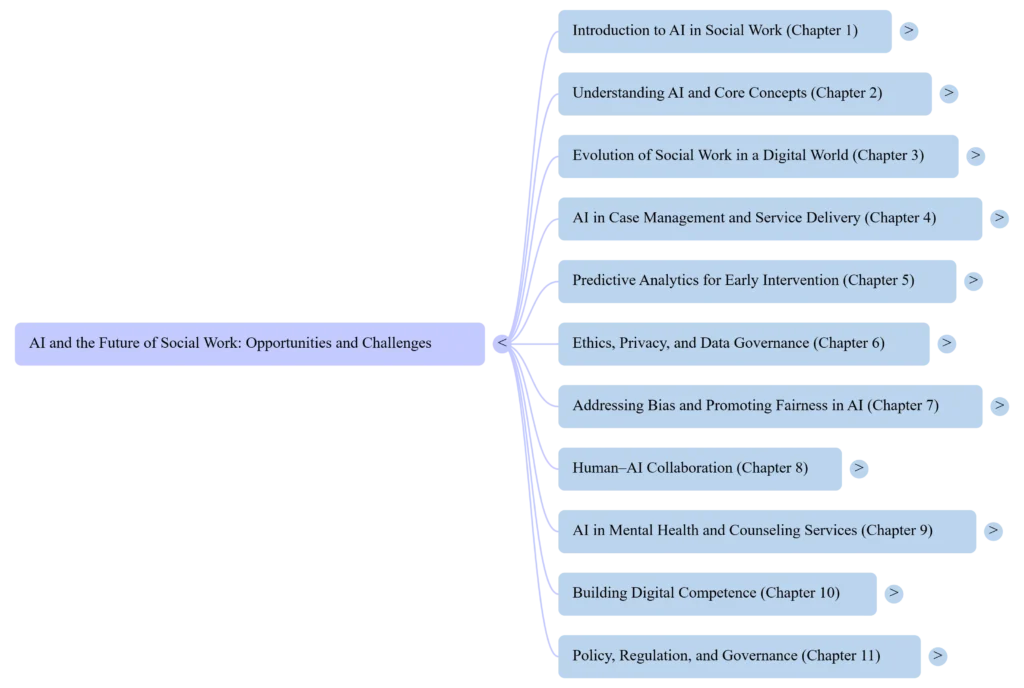
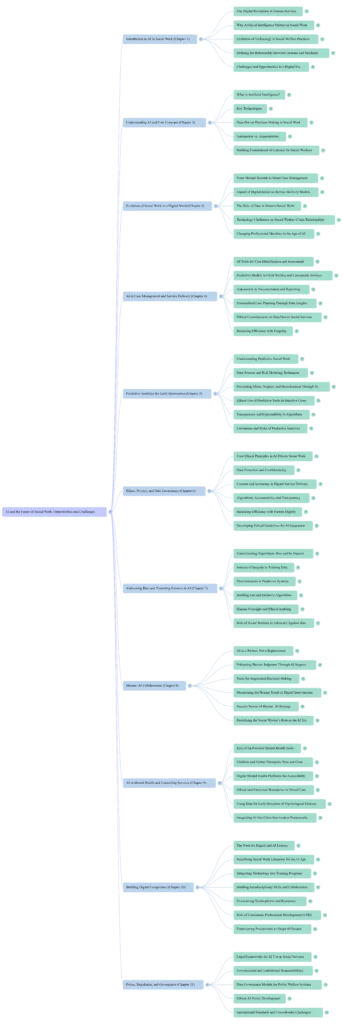
TOC / BOOK MAP (Extd.)
CHAPTERS
Chapter 1: Introduction to AI in Social Work
Introduces the digital transformation of human services, the relevance of AI in social work, global trends, and the opportunities and challenges of the digital era.
Chapter 2: Understanding Artificial Intelligence and Its Core Concepts
Explains foundational AI concepts, key technologies, data-driven decision-making, and dispels common myths while building AI literacy for social workers.
Chapter 3: The Evolution of Social Work in a Digital World
Traces the historical relationship between social work and technology, highlighting changes in service delivery, data use, and professional identity.
Chapter 4: AI in Case Management and Service Delivery
Explores AI applications in assessment, documentation, predictive modeling, and personalized care, with attention to ethics and real-world case studies.
Chapter 5: Predictive Analytics for Early Intervention
Examines how predictive tools support prevention and early action, while addressing transparency, explainability, and associated risks.
Chapter 6: Ethics, Privacy, and Data Governance
Focuses on ethical principles, data protection, consent, accountability, and international best practices for responsible AI integration.
Chapter 7: Addressing Bias and Promoting Fairness in AI
Analyzes algorithmic bias, data inequities, discrimination risks, and the role of social workers in advocating for fair and inclusive systems.
Chapter 8: Human–AI Collaboration: Augmenting Empathy with Intelligence
Highlights collaborative models where AI supports human judgment while preserving empathy, trust, and professional values.
Chapter 9: AI in Mental Health and Counseling Services
Discusses AI-powered mental health tools, virtual therapists, crisis intervention systems, and ethical boundaries in digital care.
Chapter 10: Building Digital Competence Among Social Workers
Emphasizes AI literacy, education reform, interdisciplinary skills, and continuous professional development for future-ready practitioners.
Chapter 11: Policy, Regulation, and Governance in AI-Driven Social Work
Explores legal frameworks, data governance, institutional roles, professional standards, and strategies for building public trust.
Chapter 12: The Road Ahead – Reimagining the Future of Social Work
Presents a vision for human-centered AI, future skills, global collaboration, sustainable development, and strategic policy pathways.