₹ 999.00
$99.00
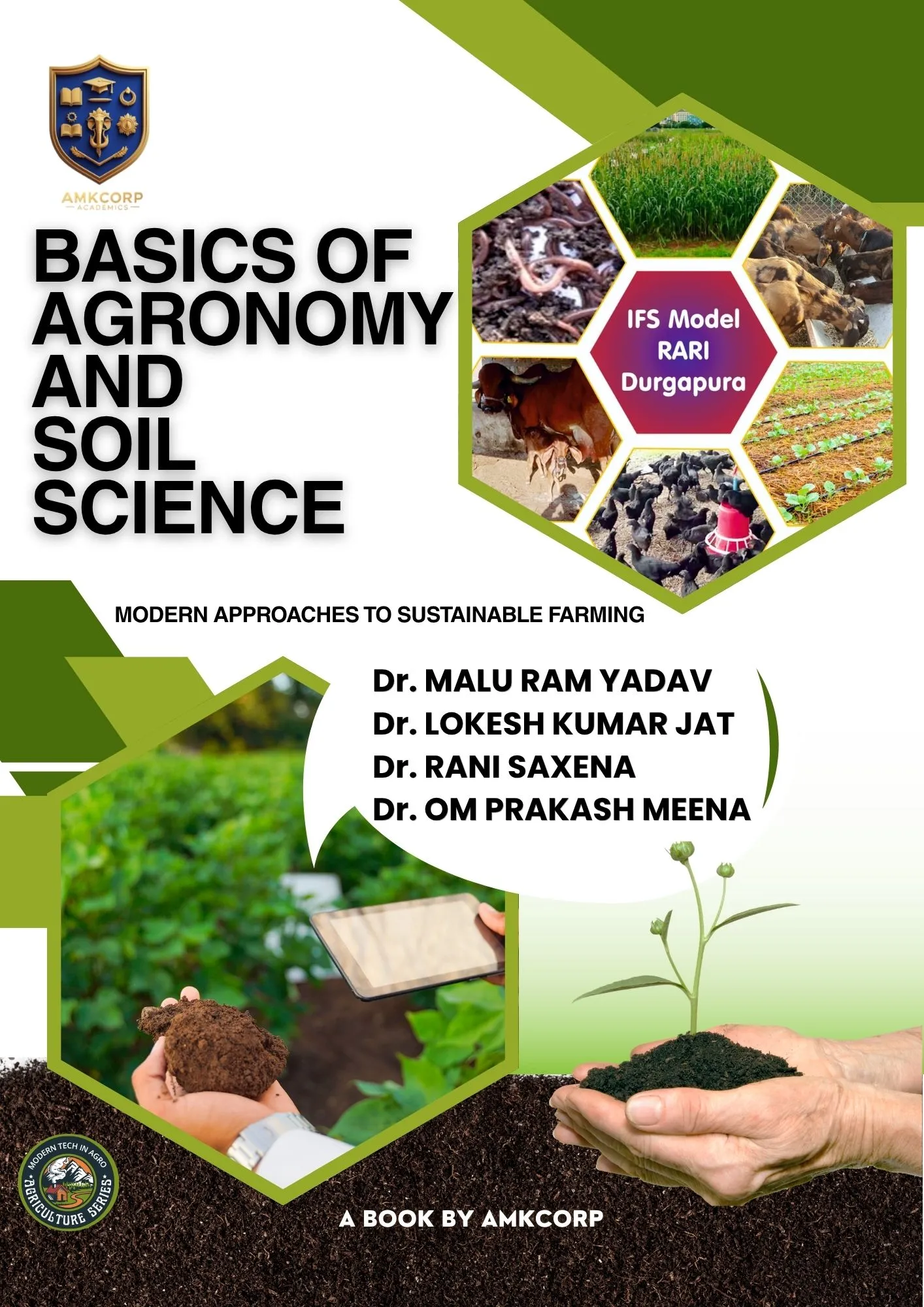
BASICS OF AGRONOMY AND SOIL SCIENCE
MODERN APPROACHES TO SUSTAINABLE FARMING
AUTHOR(S) -
Dr. MALU RAM YADAV, Dr. LOKESH KUMAR JAT,
Dr. RANI SAXENA, Dr. OM PRAKASH MEENA

DOI -10.61909/AMKEDTB042665
Genre/Subject – Agriculture, Agronomy, Soil Science.
Book code -AMKEDTB042665
pgs: 291
ISBN(P) -978-93-6556-784-7
ISBN(E) – 978-93-6556-368-9
Published – 11/04/2026
Edition – 1
BUY PRINT

BUY EBOOK
INTRODUCTION VIDEO
AUTHORS

Dr. MALU RAM YADAV
Dr. Malu Ram Yadav is a dedicated academician and researcher in the field of Agronomy, currently serving as an Assistant Professor at Sri Karan Narendra Agriculture University (SKNAU), Jaipur, Rajasthan. He completed his Bachelor’s degree in Agriculture (Honours) from S.K.N. College of Agriculture in 2013. His interest in agronomic sciences led him to pursue a Master’s degree (M.Sc.) in Agronomy from the prestigious ICAR–Indian Agricultural Research Institute, New Delhi, in 2015. Further strengthening his expertise, Dr. Yadav completed his Doctorate (Ph.D.) in Agronomy from ICAR–National Dairy Research Institute, Karnal, in 2021.
In addition to his academic achievements, Dr. Yadav gained valuable international exposure as a Visiting Scientist at the University of Western Australia. During this period, he was exposed to advanced research methodologies, modern agricultural technologies and innovative approaches to sustainable farming systems. This experience enriched his scientific outlook, enhanced his research capabilities and provided him with a global perspective on agricultural challenges, particularly in relation to climate-resilient and resource-efficient farming practices.
Since 2018, Dr. Yadav has been serving as an Assistant Professor in the Division of Agronomy, Rajasthan Agricultural Research Institute, Durgapura, Jaipur, Rajasthan. In this role, he is actively involved in teaching undergraduate and postgraduate students, mentoring young researchers and contributing to academic development.
Dr. Yadav’s research interests revolve around soil fertility management, plant nutrition, conservation agriculture, cropping/farming system agronomy, forage production and environmental conservation. His research integrates agronomic practices with environmental sustainability, aiming to develop resilient and efficient farming systems suitable for semi-arid regions of India. He has made substantial contributions to scientific literature, with more than 80 research publications in reputed national and international journals with high impact factors.
Dr. Yadav is also actively associated with professional scientific communities. He serves as a reviewer for many international and national journals and is a life member of many prestigious societies. His engagement with these professional bodies reflects his commitment to scientific advancement and knowledge sharing.
In recognition of his academic excellence and research contributions, Dr. Yadav has received several prestigious awards. He was awarded the ICAR Junior Research Fellowship (JRF) in 2013 and the ICAR Senior Research Fellowship (SRF) in 2015. His outstanding master’s research earned him the Best Thesis Award from the Indian Society of Agronomy in 2018. Further, he received the Best Ph.D. Thesis Award from the Range Management Society of India in 2022, highlighting the impact and quality of his research work.
Dr. Yadav’s career reflects a balanced integration of teaching, research and extension. His long-term vision is to contribute to sustainable agricultural development through innovative research, effective teaching and farmer-oriented solutions. He aims to address emerging challenges such as climate change, soil degradation and declining resource-use efficiency by developing practical and scientifically sound agronomic strategies. With a strong commitment to continuous learning, research excellence and student mentorship, Dr. Yadav continues to make meaningful contributions to the field of agronomy and agricultural sciences.
Dr. LOKESH KUMAR JAT
Dr. Lokesh Kumar Jat is presently serving as an Assistant Professor in the Department of Soil Science and Agricultural Chemistry at Sri Karan Narendra Agriculture University (SKNAU), Jobner, Jaipur, Rajasthan, India. He is a dedicated academician and researcher with extensive experience in teaching, research and student mentorship. With more than 7 years of teaching experience and over 12 years of research involvement, Dr. Jat has made significant contributions to the field of soil science, particularly in the areas of Integrated Nutrient Management (INM), biochar application, micronutrient dynamics, and soil fertility management.
Dr. Jat completed his Bachelor of Science (Hons.) in Agriculture from Swami Keshwanand Rajasthan Agricultural University, Bikaner. His strong academic foundation and keen interest in soil science led him to pursue higher education at one of India’s premier institutions. He obtained both his M.Sc. (Ag.) and Ph.D. degrees in Soil Science and Agricultural Chemistry from the Institute of Agricultural Sciences, Banaras Hindu University (BHU), Varanasi, Uttar Pradesh. During his postgraduate and doctoral studies, he developed expertise in soil nutrient dynamics, sustainable soil management practices, and innovative approaches to improve soil health and crop productivity.
Throughout his academic career, Dr. Jat has consistently demonstrated a commitment to excellence in both teaching and research. As an educator, he actively engages in teaching undergraduate, postgraduate, and doctoral students, imparting both theoretical knowledge and practical insights in soil science. He plays a vital role in guiding M.Sc. and Ph.D. scholars, supporting them in designing experiments, conducting research, analyzing data, and publishing scientific findings. His mentorship has contributed to the development of skilled professionals and researchers in the field of agricultural sciences.
In addition to his teaching responsibilities, Dr. Jat is deeply involved in research activities aimed at addressing real-world agricultural challenges. His work focuses on developing sustainable and efficient soil fertility management practices tailored to the agro-climatic conditions of Zone IIIa of Rajasthan. This region faces challenges such as soil degradation, nutrient deficiencies, and water scarcity. Through his research, Dr. Jat strives to identify practical and economically viable solutions that can enhance soil productivity and support farmers in improving crop yields.
Dr. Jat has an impressive record of scientific publications. He has authored and co-authored more than 30 research papers published in reputed national and international journals. His publications include original research articles, review papers, book chapters, and technical reports that contribute to the advancement of knowledge in soil science and agricultural chemistry. In addition, he has authored 3 books and booklets, which serve as valuable resources for students, researchers, and agricultural professionals.
At present, Dr. Lokesh Kumar Jat continues to dedicate his efforts toward advancing soil science research, enhancing agricultural productivity and mentoring the next generation of scientists. His work reflects a strong commitment to sustainable agriculture, environmental conservation, and farmer welfare. With his expertise, experience, and passion for agricultural research and education, he remains an important contributor to the scientific community and the agricultural sector of Rajasthan and beyond.
Dr. RANI SAXENA
Dr. Rani Saxena, Assistant Professor (Agrometeorology), Rajasthan Agricultural Research Institute (SKN Agriculture University, Jobner) Durgapura, Jaipur
Dr. Rani Saxena did her education from GBPUAT, Pantnagar (Graduation in 1998, Masters (Agrometeorology) in 2000 and Ph. D. (Agrometeorology) in 2004). She worked as teaching associate at GBPUAT, Pantanagar during 2004 to 2005 and as research associate at IARI from 2005 to 2012. She joined Sri Karan Narendra Agriculture University as Assistant Professor (Agrometeorology) at Rajasthan Agricultural Research Institute, Durgapura, Jaipur during 2012. She has more than 15 years post doctoral research experience in the field of climate change, crop simulation modelling, agroadvisory services etc. She has published more than 50 research papers in various high impact factor journals of national and international repute. She has participated in 26 national and international conferences. She has several research bulletins, scientific reports, book chapters and popular articles to her credit. She was awarded University merit fellowship during her masters and Ph. D. She was recipient of CSIR SRA fellowship and served as CSIR Pool Scientist. She has been awarded best research paper award by ‘Association of Agrometeorologists’ and Awarded Young scientist award by Society for scientific development in agriculture. Awarded for outstanding performance by IMD and Women Scientist award by Society for Bioresource and Stress Management. Awarded Best reviewer award by ‘Journal of Agrometeorology’ for outstanding in reviewing. Appreciated as Reviewer for Springer Nature.
She served as mentor for five Ph. D. and two M. Sc. students and also as a member of research advisory committee for 10 Ph. D. students. In her teaching profession, she has taught UG and PG courses. She has handled three externally funded research projects as principal investigator including one of her project of Rs 190.3 Lakhs. Contributed as cooperators in development of 7 varieties in different crops. Developed 20 production technologies included in package of practices and organized several capacity building trainings and seminars. Delivered more than 150 lectures under various capacity building programmes all over India. Visited Australia to enhance research capabilities. She has contributed through blend of intensive research and disseminating technology. She has contributed in the field of agroadvisory services to cater the needs of the farmers.
Dr. OM PRAKASH MEENA
Dr. Om Prakash Meena is a distinguished agricultural scientist and academician in the field of Agronomy. He is currently serving as a Professor of Agronomy at Sri Karan Narendra Agriculture University, Jobner, Rajasthan. With extensive experience in teaching, research and extension, he has made significant contributions to the development of sustainable crop production systems, particularly under the semi-arid conditions of Rajasthan.
Dr. Meena completed his Bachelor’s degree in Agriculture, followed by his Master’s and Doctoral degrees in Agronomy from reputed agricultural universities. His academic journey has been marked by a strong focus on improving crop productivity, resource-use efficiency and sustainability in farming systems. Throughout his career, he has demonstrated a deep commitment to advancing agronomic research and promoting scientific agriculture among farming communities.
With several years of teaching experience, Dr. Meena has been actively involved in imparting quality education to undergraduate and postgraduate students. He has taught a wide range of courses in agronomy, including crop production, nutrient management, water management, and sustainable farming practices. Known for his practical approach and clarity in teaching, he has guided numerous students in their academic and research pursuits, contributing to the development of skilled agricultural professionals.
Dr. Meena’s research work focuses on key areas such as integrated nutrient management, crop diversification and climate-resilient farming systems. His research aims to develop efficient and sustainable agronomic practices that enhance crop productivity while conserving natural resources. He has worked extensively on improving the performance of various crops through better management practices suited to the agro-climatic conditions of Rajasthan.
He has been associated with several research projects and programs, contributing to the generation of location-specific technologies for farmers. His work is particularly relevant in addressing challenges such as soil fertility decline, water scarcity and the impacts of climate change on agriculture. Through his research, he has provided practical solutions to improve farm productivity and profitability.
Dr. Meena has published many research papers in reputed national and international journals. In addition to scientific publications, he has authored popular articles and extension literature aimed at disseminating improved agricultural practices among farmers. His contributions help bridge the gap between scientific research and field-level application, ensuring that innovations reach the farming community effectively. His vision is to develop innovative and sustainable agricultural practices that ensure food security, environmental conservation, and improved livelihoods for farmers.
ABOUT BOOK / ABSTRACT
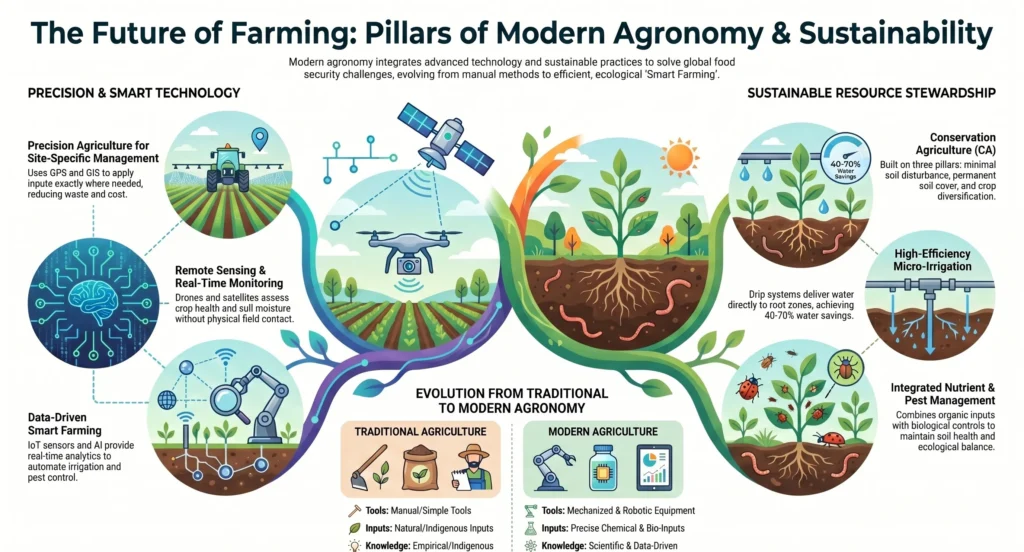
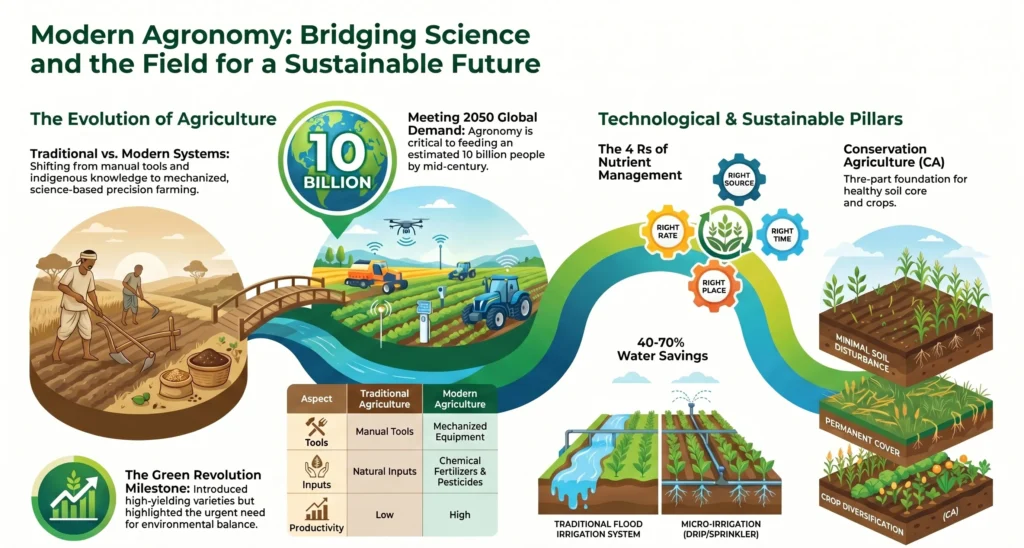
Agronomy and Soil Science: Modern Approaches to Sustainable Farming presents a comprehensive exploration of the scientific foundations and innovative practices essential for addressing the pressing challenges of contemporary agriculture. As global populations continue to rise and climate patterns become increasingly unpredictable, the need for sustainable, productive, and resilient farming systems has never been more critical. This book serves as an authoritative resource that bridges traditional agricultural knowledge with cutting-edge advancements in agronomy and soil science, offering readers practical insights into cultivating crops efficiently while safeguarding environmental health.
The volume begins by establishing core principles of agronomy and traces the evolution of agricultural practices, highlighting agronomy’s pivotal role in ensuring food security amid growing demands. It delves deeply into soil fertility, nutrient management, and soil chemistry, providing detailed understanding of soil health indicators, pH management, organic matter dynamics, and nutrient interactions. Recognizing the impacts of climate change, dedicated chapters examine greenhouse gas emissions from farming, adaptation and mitigation strategies, and the development of climate-resilient cropping systems.
Readers will find in-depth coverage of stress management in crops, encompassing abiotic stresses like drought, heat, salinity, and biotic factors, along with physiological responses and agronomic solutions. The integration of agrometeorology equips practitioners with knowledge of weather-crop relationships, forecasting tools, and climate-based planning. Sustainability is a recurring theme through discussions on conservation agriculture, soil and water conservation techniques, organic farming principles, integrated farming systems (IFS), and resource recycling.
Modern technologies take center stage in chapters on precision farming, utilizing GIS, GPS, remote sensing, automation, and site-specific management. Specialized sections detail production technologies for cereals, pulses, oilseeds, and forage crops, alongside cropping system diversification. Further, the book explores precision water management via micro-irrigation systems, emphasizing water and nutrient use efficiency through fertigation. Foundational knowledge in soil physics—including physical properties, soil water, air, and plant-water relationships—and soil biology, covering biota diversity, decomposition, enzymes, and biogeochemical cycling, complete the holistic approach.
Designed for students, researchers, extension workers, progressive farmers, and policymakers, this book combines theoretical concepts with applied strategies. It promotes integrated nutrient and pest management, resource use efficiency, and innovative solutions for livelihood security and environmental sustainability. By fostering a deep understanding of the intricate relationships between crops, soil, climate, and technology, Agronomy and Soil Science: Modern Approaches to Sustainable Farming empowers its audience to contribute meaningfully to a more food-secure and ecologically balanced future.
BOOK MAP
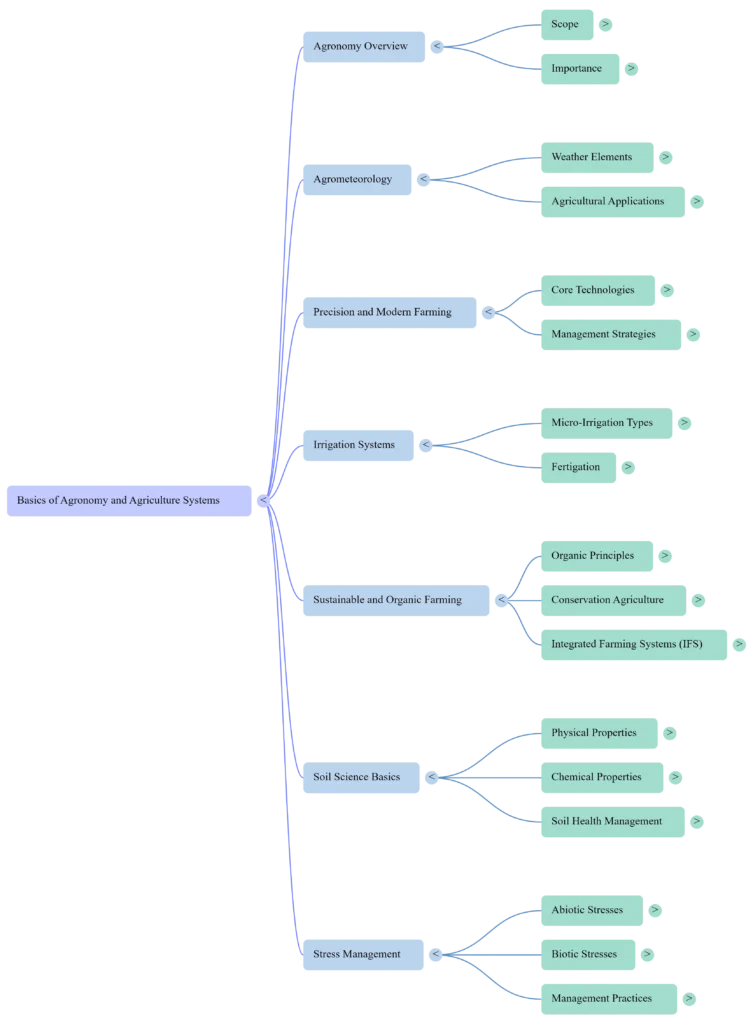
CHAPTERS
Chapter 1: Principles of Agronomy and Modern Agriculture
This foundational chapter outlines the scope, importance, and evolution of agronomy. It highlights agronomy’s vital role in ensuring food security and discusses current trends as well as emerging challenges facing global agriculture.
Chapter 2: Soil Fertility and Nutrient Management
The chapter explores concepts of soil fertility and productivity, detailing essential plant nutrients and their functions. It presents nutrient management strategies, Integrated Nutrient Management (INM) approaches, and various soil fertility evaluation methods.
Chapter 3: Soil Chemistry and Soil Health
Covering basics of soil chemistry, this chapter examines soil pH, salinity, alkalinity, and nutrient availability. It addresses chemical interactions, soil organic matter dynamics, carbon sequestration, and key indicators for assessing and managing soil health.
Chapter 4: Climate Change and Agricultural Sustainability
This chapter analyzes the impacts of climate change on agriculture and the role of farming systems in greenhouse gas emissions. It discusses adaptation and mitigation strategies, climate-resilient cropping systems, and sustainable agriculture’s contribution to climate solutions.
Chapter 5: Stress Management in Crops
Focusing on abiotic and biotic stresses, the chapter details management of drought, heat, salinity, and waterlogging. It covers physiological and molecular responses of plants and effective agronomic practices to enhance stress tolerance.
Chapter 6: Agrometeorology (Agromet) and Crop Planning
This section introduces fundamentals of agrometeorology, weather parameters affecting crop growth, and the use of weather forecasting in agriculture. It explores crop-weather models and strategies for climate-based crop planning.
Chapter 7: Conservation and Sustainable Agriculture
The chapter presents principles of conservation agriculture and various soil and water conservation techniques. It elaborates on sustainable agriculture concepts, resource use efficiency, and the environmental impacts of different farming systems.
Chapter 8: Organic Farming and Integrated Farming Systems
Dedicated to eco-friendly practices, this chapter covers principles of organic farming, organic nutrient and pest management, and certification standards. It also discusses Integrated Farming Systems (IFS) for resource optimization and recycling.
Chapter 9: Precision Farming and Modern Technologies
This chapter introduces precision agriculture concepts and applications of GIS, GPS, and remote sensing. It examines smart farming tools, automation, site-specific nutrient management, and emerging digital innovations in agriculture.
Chapter 10: Crop Production Systems (Cereals, Pulses, Oilseeds & Forage)
Providing practical production technologies, the chapter details cultivation of cereals, pulses, oilseeds, and forage crops. It also addresses cropping systems and diversification strategies for enhanced productivity and sustainability.
Chapter 11: Integrated Farming Systems
This chapter delves into the concept, principles, and components of IFS. It covers resource recycling, nutrient, water, pest, and crop management strategies, along with livelihood security, economic benefits, climate resilience, constraints, and future prospects.
Chapter 12: Precision Water Management through Micro-Irrigation
Technologies and Applications Exploring efficient water use, this chapter explains micro-irrigation concepts, types, design, and components. It highlights improvements in water and nutrient efficiency via fertigation, crop productivity gains, economic benefits, and adoption challenges.
Chapter 13: Soil Physical Properties and Processes
The chapter provides an introduction to soil physics, covering physical properties, soil water (types, moisture constants), soil air, temperature regimes, and soil-plant-water relationships. Management strategies for physical constraints are also discussed.
Chapter 14: Soil Biological Activity and Biochemical Functions
Focusing on living components, this chapter introduces soil biology and biochemistry. It details soil biota diversity and functions, organic matter decomposition, soil enzymes, and key nutrient cycling and biogeochemical processes.