₹ 999.00
$99.00
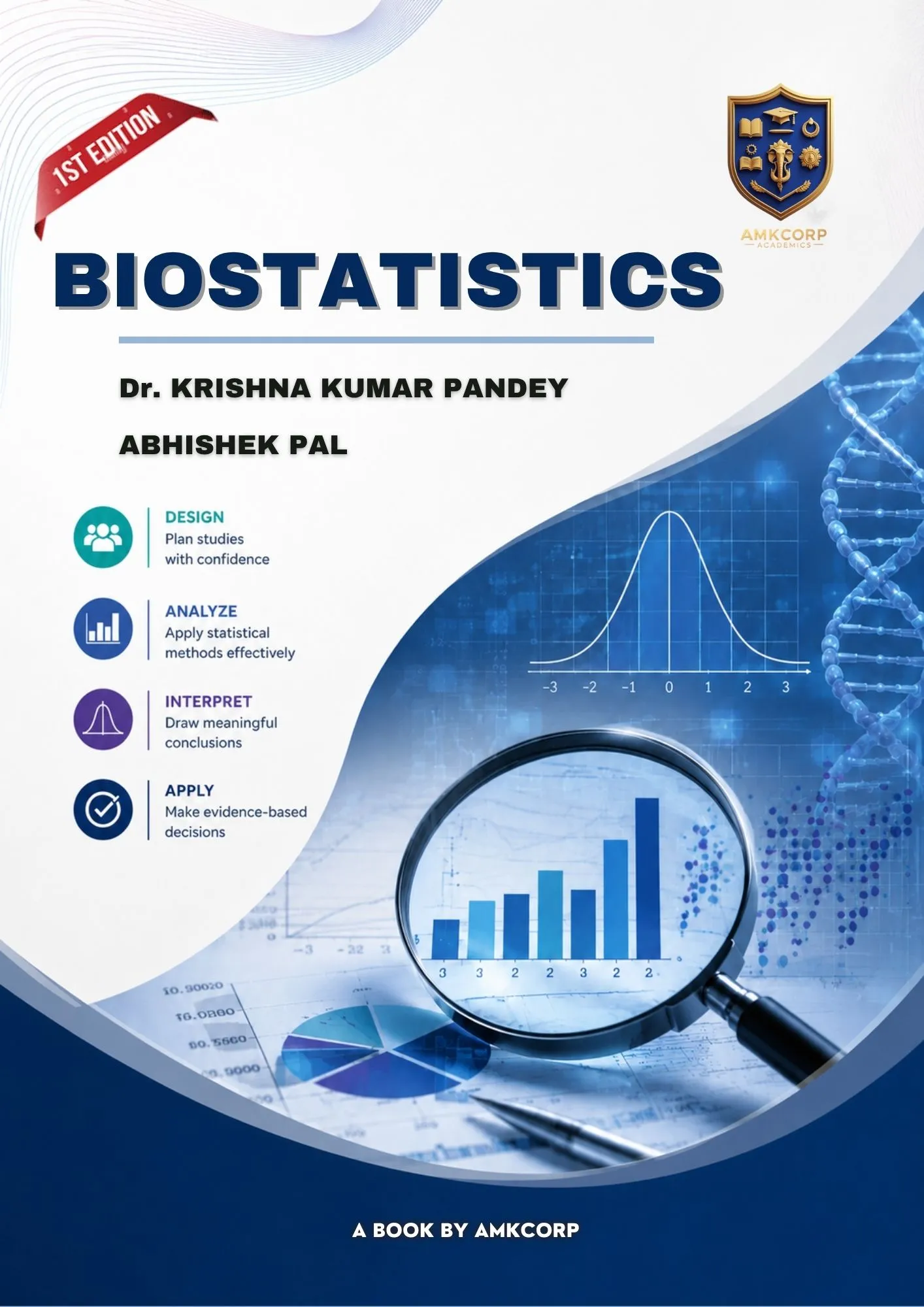
BIOSTATISTICS
AUTHOR(S) -
Dr. KRISHNA KUMAR PANDEY
ABHISHEK PAL

DOI – 10.61909/AMKEDTB062678
Genre/Subject – Biostatistics
Book code – AMKEDTB062678 pgs: 160
ISBN(P) – 978-93-6556-012-1
ISBN(E) – 978-93-6556-011-4
Published – 15/06/2026
Edition – 1
BUY PRINT

BUY EBOOK
AUTHORS

Dr. KRISHNA KUMAR PANDEY
Dr. K. K. Pandey has approximately 15 years’ experience in Teaching and Research. He Completed his B.Sc. (Ag.) in 2004 with “Merit Scholar Award” and completed his M.Sc. (Ag.) in Agricultural Statisticswith “Gold Medal Award”and Ph.D.Agricultural Statistics from Acharya Narendra Deva University of Agriculture & Technology (ANDUAT), Kumarganj, Ayodhya, in 2006 and 2011 respectively. He served in NRC, Jhansi (SRF), VCSG, Bharsar (TRP) and more than 10 years in IGKV as Assistant Professor (Agricultural Statistics) and presently working as Associate Professor (Agricultural Statistics) at A.N.D.U.A.&T., Kumarganj, Ayodhya from 2024. He has 3 Patents, more than 5 Book Chapters and More than 50 Research papers in reputed NAAS rated Journals. He has been guided more than 10 PG student As a Major guide and 5 Ph.D. Students as a member. He has expertise in Forecast modeling and Environmental Modeling.

ABHISHEK PAL
Mr. Abhishek Pal is a Ph.D. Scholar in Agricultural Statistics at Acharya Narendra Deva University of Agriculture Technology (ANDUAT), Kumarganj, Ayodhya. He completed his B.Sc. (Hons.) Horticulture in 2023 from Banda University of Agriculture Technology, Banda, and completed his M.Sc. (Ag.) in Agricultural Statistics in 2025 from ANDUAT, specializing in Time Series Analysis. Currently, his doctoral research focuses on Carbon Sequestration and Model Development for estimating carbon stock and sequestration potential of standing trees. His work contributes to environmental monitoring, campus level carbon accounting and climate change mitigation planning. His academic interests include Experimental Designs; ANOVA and variance analysis. 2 research papers have been published in reputed NAAS rated journals and 1 book chapter has been contributed in an edited volume. The scholarly journey reflects a strong commitment to advancing the field of Agricultural Statistics, with emphasis on statistical applications in agriculture and environmental sustainability research.
ABOUT BOOK / ABSTRACT
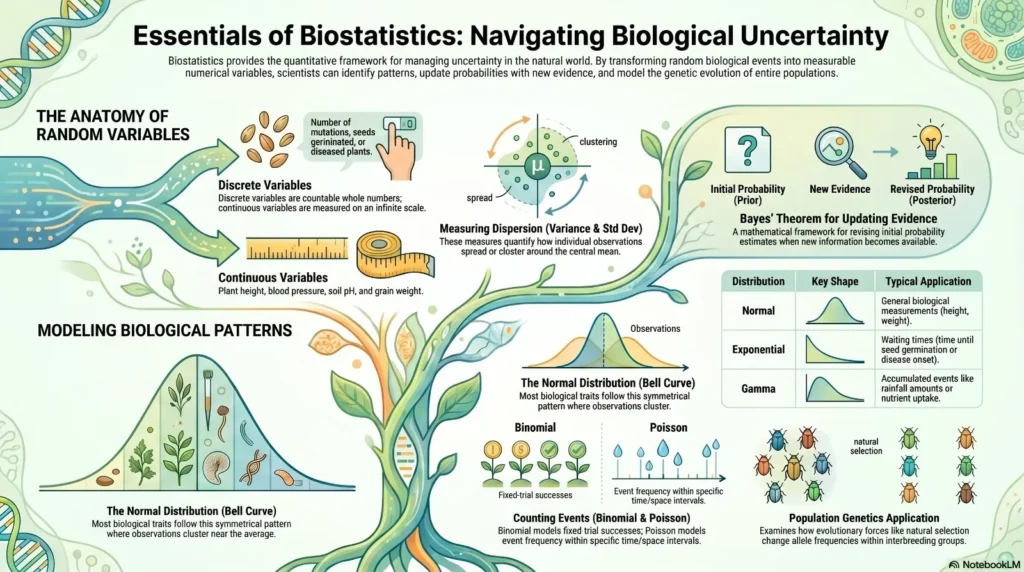
Biostatistics is an essential discipline that integrates statistical principles with biological, agricultural, medical, and environmental sciences. This book has been carefully designed to provide students, researchers, and professionals with a comprehensive understanding of statistical methods and their applications in biological research. It serves as a bridge between theoretical statistical concepts and practical biological problems, enabling readers to analyze, interpret, and draw meaningful conclusions from scientific data.
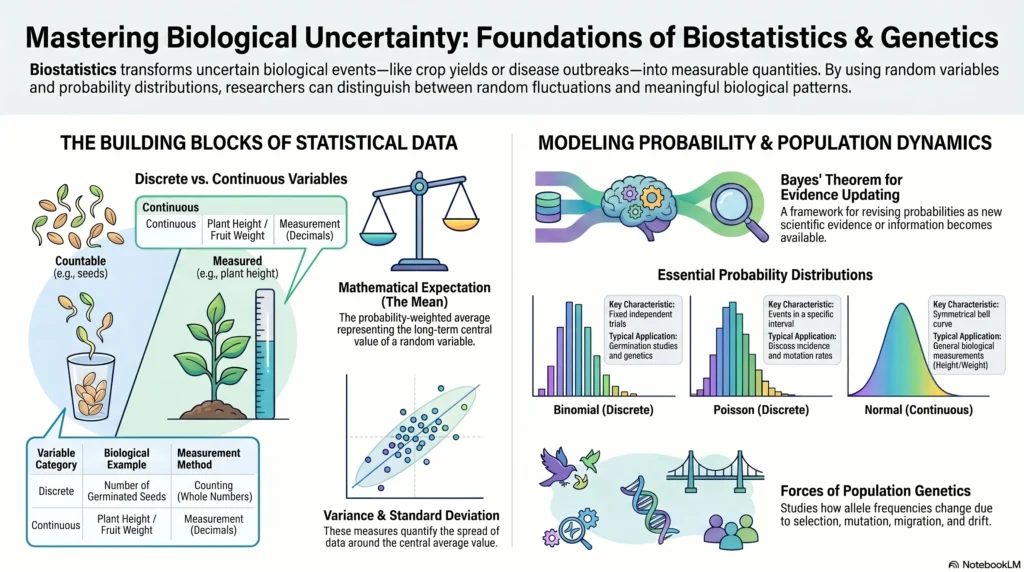
The book begins with a detailed introduction to random variables and probability distributions, which form the foundation of statistical reasoning. Readers are guided through probability functions, mathematical expectation, variance, conditional probability, and Bayes’ theorem, followed by an in-depth discussion of important discrete and continuous probability distributions. These concepts are presented in a clear and systematic manner, making them accessible even to learners who are new to statistical sciences.
The second section focuses on population genetics and stochastic processes, highlighting their significance in biological and agricultural research. Topics such as random mating populations, Hardy–Weinberg equilibrium, Poisson processes, Markov chains, transition probabilities, and random walk models are explored with practical examples and biological applications. Special emphasis is placed on understanding genetic structures and predicting biological outcomes through probabilistic models.
The third section addresses statistical genetics and experimental design, which are indispensable tools in modern biological investigations. Readers are introduced to chi-square tests, linkage analysis, analysis of variance, analysis of covariance, and incomplete block designs. These methods help researchers evaluate experimental data, test hypotheses, and understand genetic variation in populations. The content is structured to promote analytical thinking and strengthen quantitative skills required for scientific research.
In addition to theoretical discussions, the book includes an extensive practical component that enables learners to apply statistical techniques to real-world problems. Exercises on probability distributions, Hardy–Weinberg equilibrium, Markov chains, linkage detection, ANOVA, ANCOVA, heritability estimation, and computer-based statistical analysis provide hands-on experience. The inclusion of statistical software applications further enhances the practical relevance of the book.
Written in a student-friendly style, this book is an invaluable resource for undergraduate and postgraduate students in life sciences, agriculture, biotechnology, genetics, and related disciplines. It also serves as a useful reference for researchers seeking to strengthen their understanding of biostatistical methods. By combining theory, applications, and practical exercises, the book aims to develop a strong foundation in biostatistics and prepare readers for advanced research and data-driven decision-making in the biological sciences.