₹ 999.00
$99.00
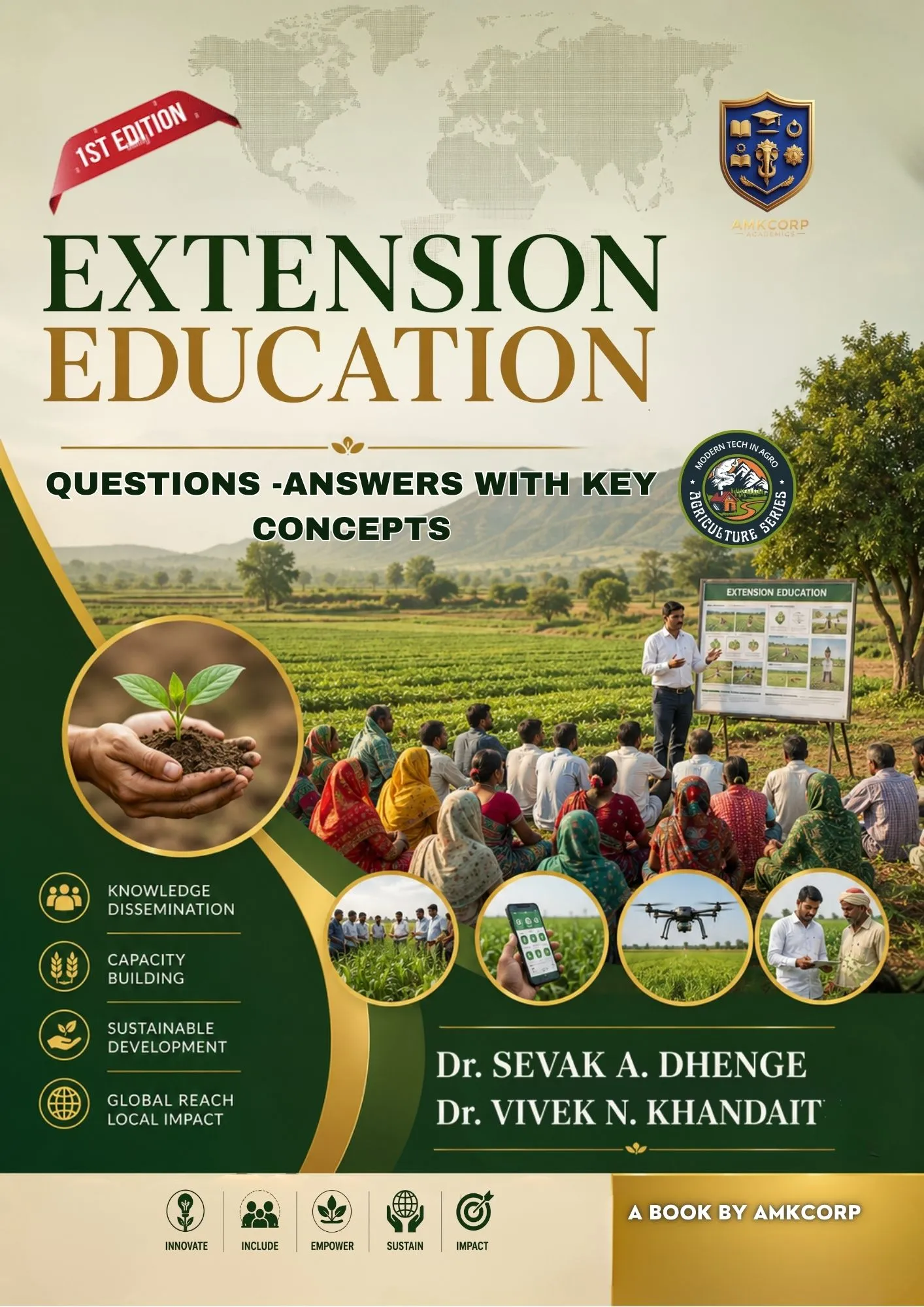
EXTENSION EDUCATION
QUESTIONS-ANSWERS WITH KEY CONCEPTS
AUTHOR(S) -
Dr. SEVAK A. DHENGE
Dr. VIVEK N. KHANDAIT

DOI – 10.61909/AMKEDTB072684
Genre/Subject -Agriculture, Agricultural Extension, Education
Book code -AMKEDTB072684
pgs: 180
ISBN(P) -978-93-6556-023-7
ISBN(E) – 978-93-6556-022-0
Published – 30-07-2026
Edition – 1
BUY PRINT

BUY EBOOK
DECK
AUTHORS

Dr. SEVAK A. DHENGE
Dr. Sevak A. Dhenge is working as Assistant Professor in Department of Agricultural Extension at Rani Avanti Bail Lodhi College of Agriculture and Research Station (Constituent College of IGKV, Raipur), Chhuikhadan. He has presently teaching the various agricultural extension courses under the B.Sc. Agri (Hon.) degree programme. He has qualified four times ICAR NET exam. He has published four books, books chapter, 25 research abstract, 23 research paper in NAAS rated and high impact factor journals, over 110 popular articles. He has participated in 15 National, 2 International Seminar and 4 National level training programme. He has coordinated more than 15 online training programs. He has delivered one Radio talks. He has awarded as Best Author award of Krishidoot magazine, Innovative Agriculture Scientist Awards (Krishithon) and Young Scientist Teacher Awards.

Dr. VIVEK N. KHANDAIT
Dr. Vivek N. Khandait is working as Subject Matter Specialist in Department of Veterinary and Animal Husbandry Extension Education at College of Veterinary and Animal Sciences, Udgir (Constituent College of MAFSU, Nagpur). He is engaged in teaching the various extension courses to B.V.Sc & A.H. and M.V.Sc degree programme. He has published 10 research abstract, 25 research paper in NAAS rated and high impact factor journals, over 50 popular articles. He has participated in 20 National, 4 International Seminar and 6 National level training programme. He has coordinated more than 35 training programs and delivered more than 100 talks in farmers training and also delivered 8 Radio talks. He has awarded as Best Ph.D. Thesis award from DUVASU Mathura, Krushivir Awards (Agrotech Magzine) and Sant Gadgebaba Award for service in social sector through extension education.
ABOUT BOOK / ABSTRACT
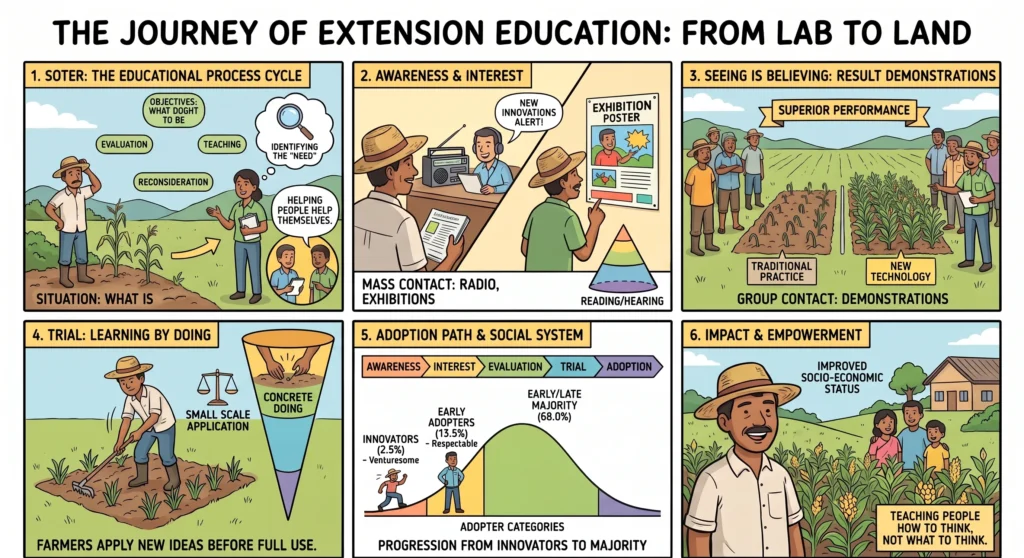
Presently, agriculture sectors has harvested by adopting the modern technologies and information. The various approaches has be evolved in context of the technologies outreach to the farmers field by participatory and bottom approach. Looking the opportunities all the agriculture subjects implementing coordinate efforts to produce and disseminate appropriate technologies among the farmers to get agriculture sector more profitable. Among one is agricultural extension play important role to bridge the gap between researcher and farmers. In this subject have a various theories, principles, approaches; methodologies to applied while delivering the technologies. So, those students are interested to make their career in this subject also those preparing the various national and state level exams including IBPS, PG & Ph.D. entrance of SAUs etc there is need to understand the various subject matter deeply of the subject. Considering the demands of various competitive national and state level exams, the book is specially designed and structure. The book is structure by one line questions with answers also fulfilling the doubts of the readers by overlooking the key concepts of the various topics bringing out at the back side of the book in very concise and comprehensive manner. This book is not only helpful to competitive preparation but also UG students, teachers, officials of state department, officials of NGO and researcher for understanding the extension education subject matter in concise way. The book titled “EXTENSION EDUCATION (QUESTIONS-ANSWERS WITH KEY CONCEPTS)” consists of 8 chapters: first 6 chapters namely, Basics of Extension Education, Communication, Adoption and diffusion, Rural Sociology, Entrepreneurship, Emerging areas of Extension Education provided one word questions with answers which can reader easily understand the questions immediately remaining two chapters are conceptually frame for better understanding the terminologies also provide the expected abbreviations.
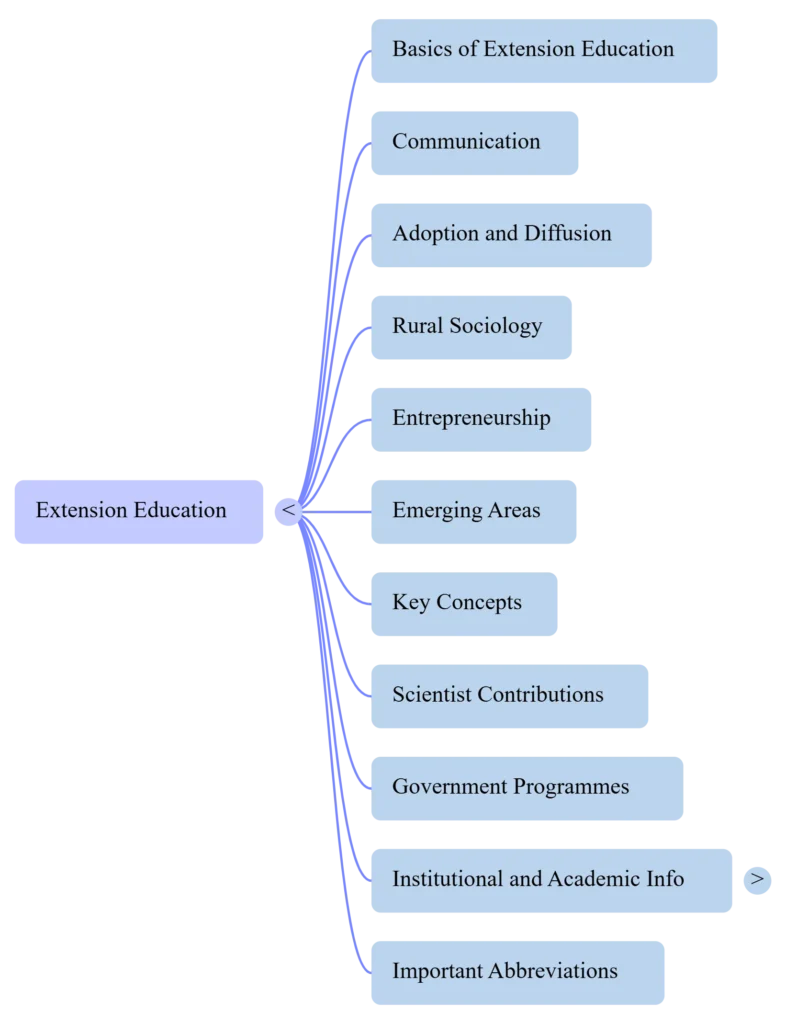
BOOK MAP
CHAPTERS
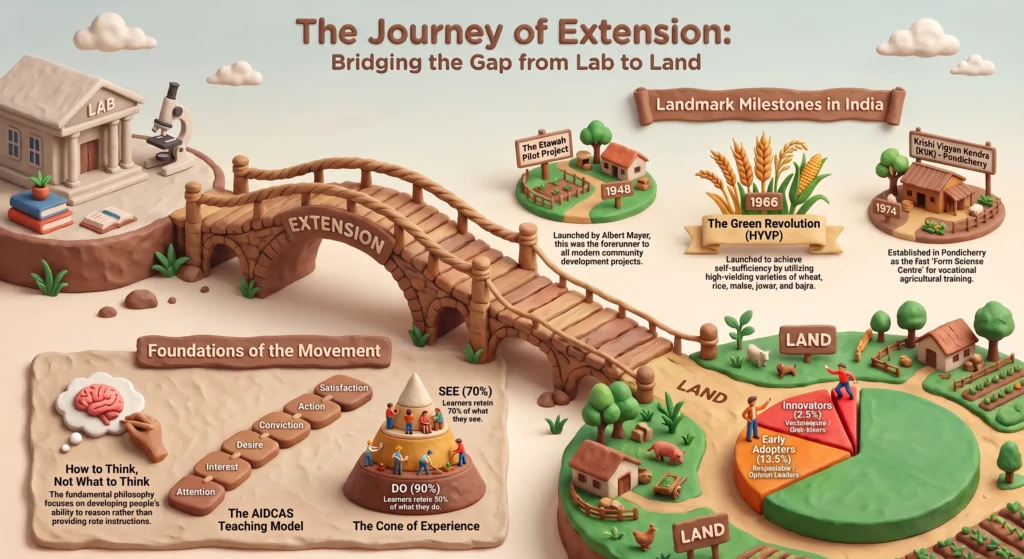
1. Basics of Extension Education
This chapter introduces the fundamentals, objectives, principles, scope, and importance of extension education.
It explains how extension education facilitates knowledge transfer and supports agricultural and rural development.
2. Communication
This chapter explains the meaning, elements, types, methods, and importance of communication in extension education.
It highlights effective communication techniques for transferring agricultural information and influencing behavioural change.
3. Adoption and Diffusion
This chapter deals with the processes through which new ideas, technologies, and agricultural practices spread among people.
It explains adoption behaviour and the factors influencing the acceptance and diffusion of innovations.
4. Rural Sociology
This chapter introduces the social structure, institutions, relationships, and characteristics of rural communities.
It explains the role of social factors in understanding rural life and implementing agricultural development programmes.
5. Entrepreneurship
This chapter introduces entrepreneurship, entrepreneurial characteristics, opportunities, and the entrepreneurial process.
It highlights the importance of entrepreneurship in agricultural development, employment generation, and rural economic growth.
6. Emerging Areas of Extension Education
This chapter discusses new and developing areas that are expanding the scope of extension education.
It highlights changing approaches, technologies, and emerging opportunities for delivering agricultural knowledge and services.
7. Key Concepts
This chapter provides important concepts and terminology relevant to extension education and its associated fields.
It serves as a concise reference for understanding fundamental ideas frequently used in extension studies.
8. Scientist and Contribution
This chapter presents important scientists and their notable contributions to agriculture and extension-related development.
It provides a quick reference to key personalities and their roles in advancing agricultural knowledge and practices.
9. Different Government Programmes
This chapter introduces important government programmes related to agriculture, rural development, and extension services.
It explains their relevance in supporting farmers, rural communities, agricultural development, and welfare initiatives.
10. Journals of Extension, Word Origin, AU, DAU, CAU, ICAR Project and KVK
This chapter provides reference information on extension journals, important terminology, agricultural universities, ICAR projects, and KVKs.
It brings together institutional and general knowledge useful for students and professionals of agricultural extension.
11. Important Abbreviations
This chapter compiles important abbreviations commonly used in agricultural extension, education, research, and government programmes.
It provides a quick-reference resource for understanding frequently encountered short forms and institutional terms.