₹ 999.00
$99.00
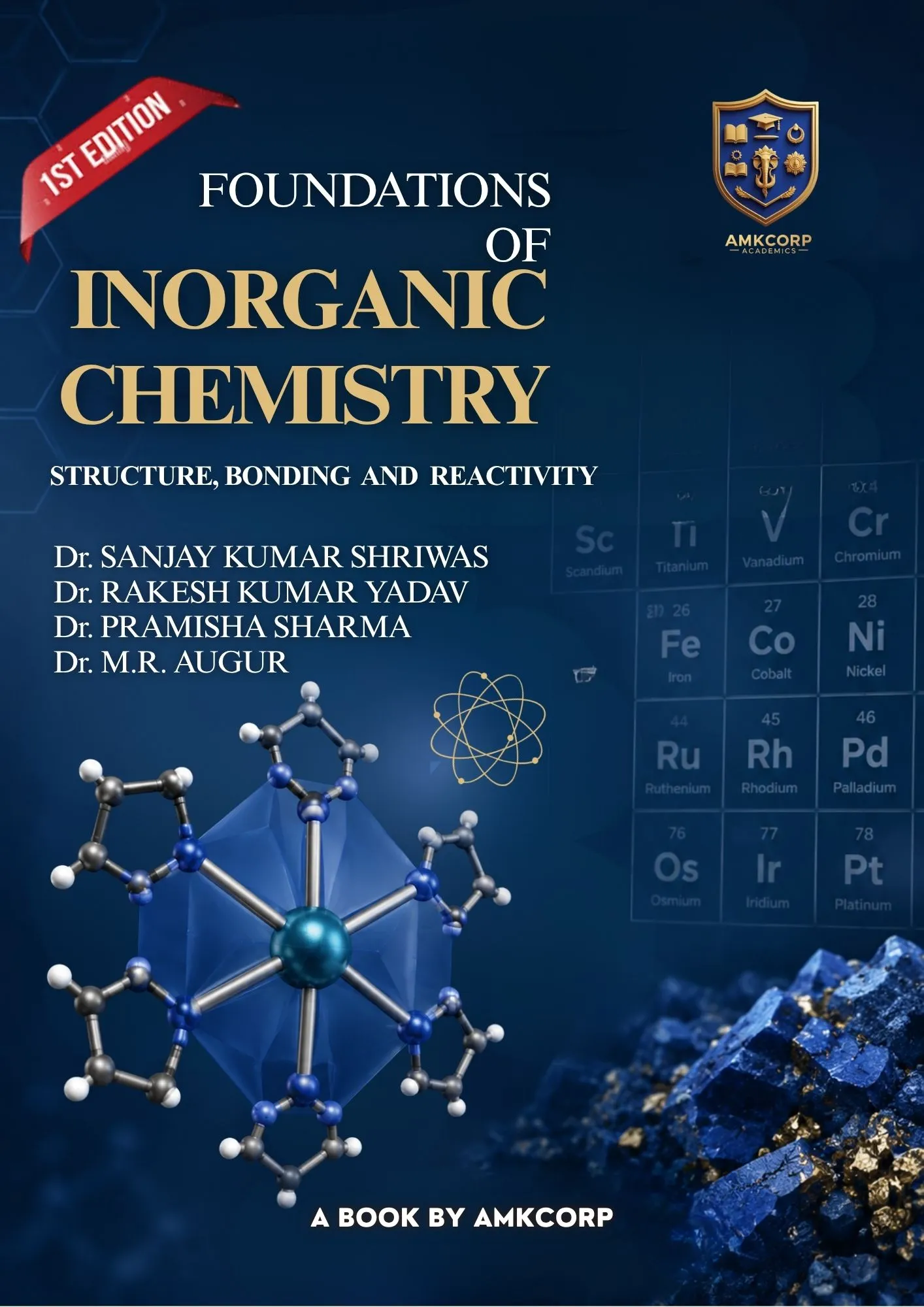
FOUNDATIONS OF INORGANIC CHEMISTRY
STRUCTURE, BONDING AND REACTIVITY
AUTHOR(S) -
Dr. SANJAY KUMAR SHRIWAS
Dr. RAKESH KUMAR YADAV
Dr. PRAMISHA SHARMA
Dr. M.R. AUGUR

DOI – 10.61909/AMKEDTB052672
Genre/Subject – Chemistry
Book code – AMKEDTB032660 pgs: 250
ISBN(P) -978-93-6556-112-8
ISBN(E) – 978-93-6556-013-8
Published – 04/05/2026
Edition – 1
BUY PRINT
BUY EBOOK
INTRODUCTION VIDEO
AUTHORS
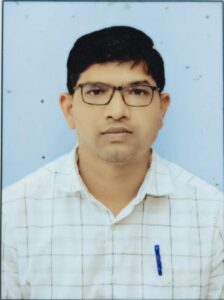
Dr. SANJAY KUMAR SHRIWAS
Dr. Sanjay Kumar Shriwas is an accomplished academician, currently serving as Assistant Professor of Chemistry at Mahant Shri Ramjanki Sharan Das Vaishnav Government College, Pipariya, District Kabirdham, Chhattisgarh, India. He holds an M.Sc. degree in Chemistry from Guru Ghasidas University, Bilaspur, and earned his M.Phil. and Ph.D. degrees from Dr. C.V. Raman University, Kargi Road, Kota, Bilaspur, Chhattisgarh. With over 16 years of teaching experience in colleges and universities, he has contributed significantly to higher education, student development, and the advancement of chemical sciences. Throughout his career, Dr. Shriwas has actively participated in orientation programmes, refresher courses, workshops, and training programmes, thereby enhancing his academic and professional expertise. Dedicated to imparting quality education, he continues to inspire students through his deep knowledge, mentorship, and commitment to academic excellence.
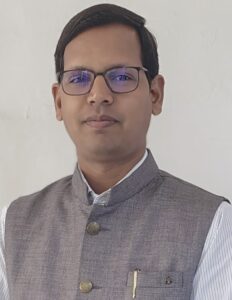
Dr. RAKESH KUMAR YADAV
Dr. Rakesh Kumar Yadav is an Associate Professor in the Department of Chemistry at Dr. C. V. Raman University Kargi Road Kota, Bilaspur, Chhattisgarh India, 495113 (‘A’ Graded By NAAC). He has obtained post-graduate in M.Sc. (Chemistry) from Guru Ghasidas University Bilaspur (C.G.), PGDCA, M.Phil (Physical Chemistry) and Ph.D. (Chemistry) from Dr. C.V. Raman University. He has received no. of Awards for his Excellence in Teaching & Research from different National & International organization. He has various life memberships from different organizations, at national and international levels. He has published 3 Book & number of research articles and book chapter in reputed Journals (National and International). He has Published 3- Indian Patent. He has no. of Ph.D. scholar under his supervision. He has also no. of M.Phil (Chemistry) and post graduate students (Project & Dissertation) under his supervision. He has presented a number of papers in National and International conferences and symposium, Chaired sessions in national and international seminars and conferences, and also attended workshops, faculty development programs, training programs, orientation programs, and refresher courses. He has presented on different online and offline platforms as a resource person, guest lecturer, and chief speaker. He has evaluated no. of PhD Thesis and taken final viva-voce of PhD Scholar as external examiner in various Institutions. He has reviewer in no. of national & international research journal. He has over 16 years of teaching experience in the area of Engineering and Science UG, PG and Course Work of Research (Ph.D) Programmed. He has delivered his best academic knowledge and skills to the organization.

Dr. PRAMISHA SHARMA
Dr. Pramisha Sharma is a distinguished academician in the field of Chemistry, currently serving as an Assistant Professor at the Shri Shankaracharya Institute of Professional Studies (SSIPS) in Raipur, Chhattisgarh. Her career is marked by a deep commitment to environmental chemistry and the assessment of water quality in the Chhattisgarh region. Dr. Sharma holds an extensive educational background in the chemical sciences. Ph.D. in Chemistry, Awarded by Dr. C.V. Raman University, Kargi Road Kota, Bilaspur, Chhattisgarh. Dr. Sharma’s research primarily focuses on Environmental Chemistry, with a specific emphasis on the physico-chemical analysis of water resources. Her work often addresses the health implications of heavy metal contamination in rural and semi-urban blocks of Chhattisgarh.

Dr. M.R. AUGUR
Dr. M.R. Augur is a distinguished academician and chemist currently serving as a Professor in the Department of Chemistry at Government Agrasen P.G. College, Bilha, located in the Bilaspur district of Chhattisgarh. With a career spanning over 37 years, he has significantly contributed to chemical education and research in the region. As a senior faculty member at Government Agrasen College, Bilha—an institution affiliated with Atal Bihari Vajpayee University (ABVU), Bilaspur—Dr. Augur possesses extensive teaching experience at both undergraduate and postgraduate levels. He has been instrumental in shaping the science curriculum for the rural student population of the Bilha block, ensuring high-quality education is accessible to all. Research and Supervision While the college focuses primarily on teaching, Dr. Augur is a recognized Research Supervisor for the affiliating university, Atal Bihari Vajpayee Vishwavidyalaya. Specialization: His expertise is primarily centered on Inorganic Chemistry. Dr. Augur has played a vital role in developing academic resources for distance and higher education in Chhattisgarh: Author & Editor: He edited the Inorganic Chemistry textbooks for the B.Sc. I, II, and III-year programs at Pt. Sundar Lal Sharma (Open) University, Bilaspur. Practical Manuals: He authored the B.Sc. practical laboratory manuals for the same university, ensuring standardized practical training for distance-learning students.
ABOUT BOOK / ABSTRACT
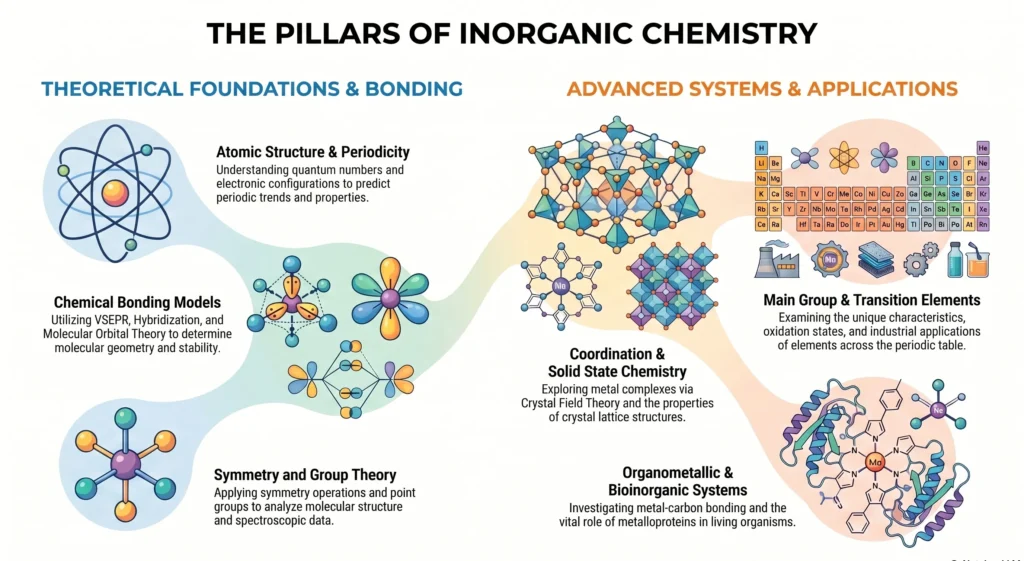
Foundations of Inorganic Chemistry: Structure, Bonding, and Reactivity is a comprehensive and academically enriched textbook designed to provide students, researchers, and educators with a strong conceptual understanding of inorganic chemistry and its modern applications. The book systematically explores the fundamental principles governing the structure, properties, bonding, and reactivity of inorganic substances, while also connecting classical theories with contemporary developments in chemistry and material science. Written in a clear and student-friendly manner, this book serves as an essential resource for undergraduate and postgraduate learners pursuing chemistry, pharmaceutical sciences, biotechnology, materials science, and related disciplines.
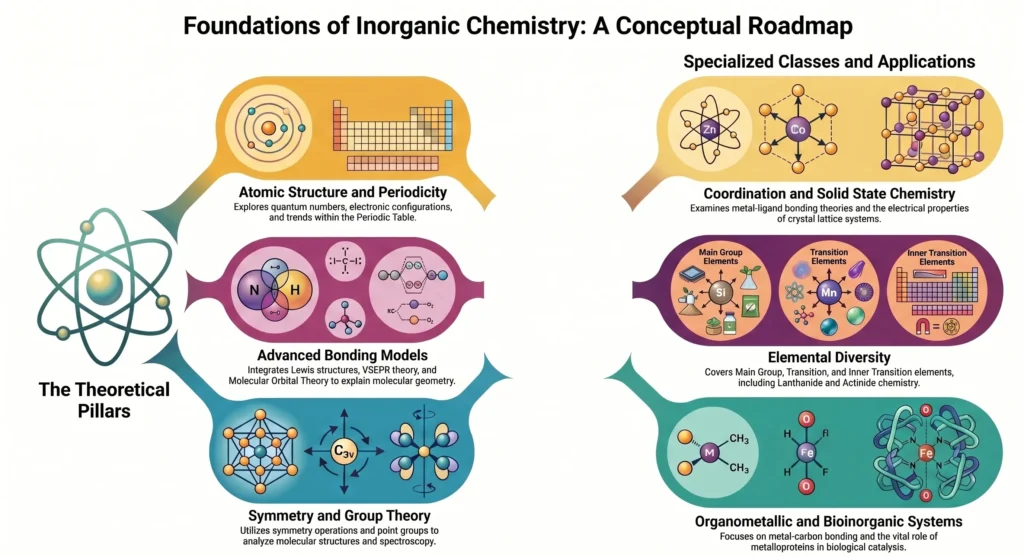
Beginning with the historical evolution and scope of inorganic chemistry, the book introduces readers to the core concepts that form the backbone of the subject. It explains atomic structure, quantum theory, periodic trends, and electronic configurations in a logical sequence that helps readers build a strong theoretical foundation. Detailed discussions on chemical bonding, molecular geometry, hybridization, and molecular orbital theory enable students to understand how atoms interact and form stable compounds with distinct physical and chemical properties.
The text further advances into important areas such as symmetry and group theory, coordination chemistry, solid-state chemistry, acid-base theories, and non-aqueous solvents. These chapters are carefully structured to explain complex concepts through simplified descriptions and practical examples, making advanced inorganic chemistry more accessible to learners. Special emphasis is placed on crystal field theory, ligand field theory, molecular symmetry, and spectroscopic applications, which are crucial for understanding modern inorganic systems and analytical techniques.
In addition to theoretical aspects, the book extensively covers the chemistry of main group elements, transition metals, lanthanides, actinides, and organometallic compounds. Readers gain insight into the diverse chemical behavior, industrial importance, catalytic applications, and biological significance of inorganic compounds. The inclusion of bioinorganic chemistry highlights the role of metals in living systems, metalloproteins, and biochemical processes, bridging the gap between inorganic chemistry and biological sciences.
A distinguishing feature of this book is its balanced approach between foundational knowledge and real-world applications. Topics such as catalysis, industrial materials, magnetic and electrical properties of solids, and emerging trends in inorganic chemistry provide readers with a modern perspective on how inorganic chemistry contributes to technology, medicine, environmental science, and advanced materials research.
Carefully organized and pedagogically structured, the book encourages analytical thinking, conceptual clarity, and scientific curiosity. Each chapter is designed to guide learners progressively from basic principles to advanced applications, making the text suitable for classroom teaching, competitive examinations, self-study, and research preparation. Overall, Foundations of Inorganic Chemistry: Structure, Bonding, and Reactivity serves as a valuable academic companion for anyone seeking a thorough and practical understanding of inorganic chemistry in both traditional and modern scientific contexts.
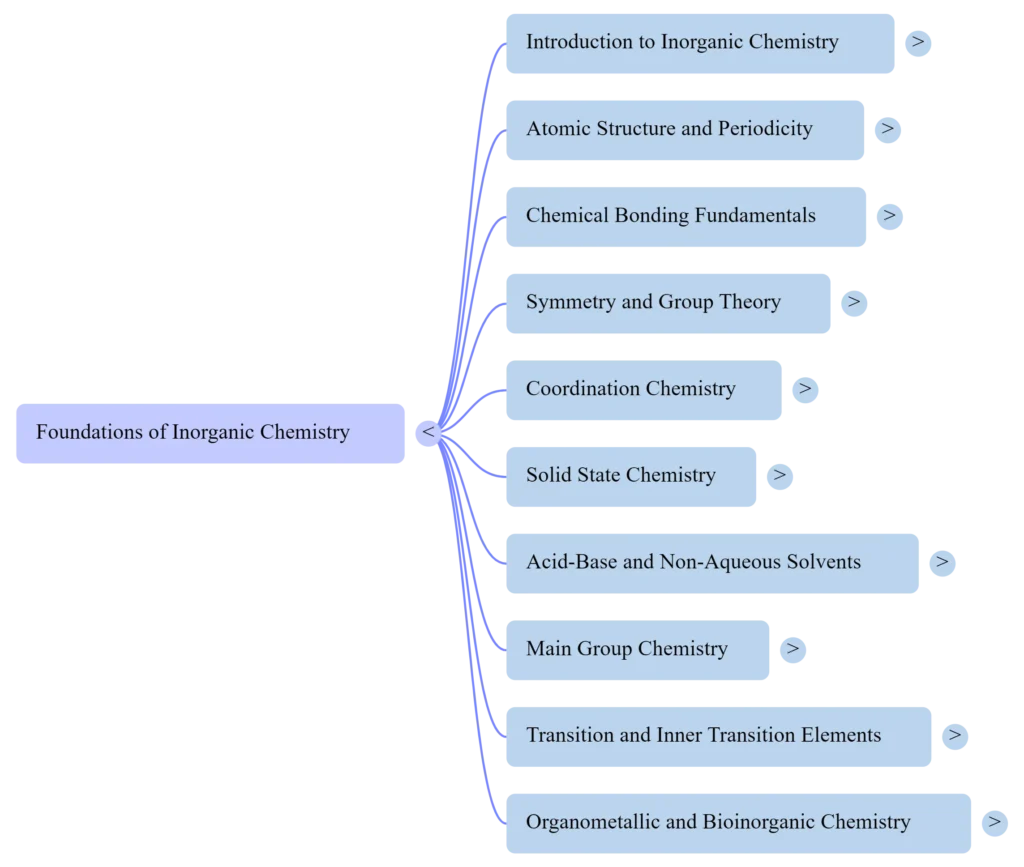
BOOK MAP
CHAPTERS
Chapter 1: Introduction to Inorganic Chemistry
This chapter introduces the scope, historical development, and significance of inorganic chemistry in modern science. It explains the classification of elements and compounds along with the basic concepts and terminology essential for understanding the subject.
Chapter 2: Atomic Structure and Periodicity
This chapter discusses the structure of atoms, quantum numbers, orbitals, and electronic configurations. It also explains periodic trends and the relationship between atomic structure and chemical properties.
Chapter 3: Chemical Bonding Fundamentals
The chapter focuses on ionic and covalent bonding, molecular geometry, hybridization, and molecular orbital theory. It helps readers understand how atoms combine to form stable molecules and compounds.
Chapter 4: Symmetry and Group Theory
This chapter explores symmetry elements, symmetry operations, point groups, and their applications in molecular structure analysis. It also highlights the importance of group theory in spectroscopy and inorganic chemistry.
Chapter 5: Coordination Chemistry
This chapter provides detailed knowledge of coordination compounds, nomenclature, isomerism, and bonding theories. Crystal field theory and ligand field theory are explained to understand the properties of metal complexes.
Chapter 6: Solid State Chemistry
The chapter covers crystal systems, unit cells, lattice structures, and defects in solids. It also explains the electrical, magnetic, and industrial applications of solid materials.
Chapter 7: Acid-Base and Non-Aqueous Solvents
This chapter discusses different acid-base theories including Bronsted-Lowry and Lewis concepts. It also explains the behavior of substances in non-aqueous solvents and their industrial significance.
Chapter 8: Main Group Chemistry
The chapter examines the general characteristics and chemical behavior of main group elements. It highlights trends, anomalies, and the chemistry of Groups 1 to 18.
Chapter 9: Transition and Inner Transition Elements
This chapter explains the properties, oxidation states, and complex formation of transition metals. It also discusses lanthanides, actinides, and their industrial and catalytic applications.
Chapter 10: Organometallic and Bioinorganic Chemistry
The final chapter introduces organometallic compounds, metal-carbon bonding, and catalytic applications. It also explores bioinorganic systems, metalloproteins, and future developments in inorganic chemistry.